
Last updated November 16, 2026
 Wrought iron
 Wood & steel frame
 Farm & ranch
 Sliding driveway gates
 LiftMaster operators
Free on-site gate assessment - hinges, posts, and your LiftMaster or Nice gate operator checked before anything is quoted
The assessment is free and the quote is the invoice.
Get your free estimateGate Repair Maintenance Schedule: What to Do and When
Lubricating a gate every six months sounds responsible until you realize chain stretch, battery voltage drop, and loop detector drift all fail on completely different clocks. Hitting them all on the same visit means you’re always late on something. A gate is a mechanical system, an electrical system, and a safety system bolted into one frame, and each layer wears out on its own timeline. In this guide, we lay out a task-by-task maintenance schedule built around how gate parts actually fail, not a generic interval copied from a checklist. You’ll learn what to check monthly as an owner, what belongs in quarterly mechanical service, and what only an annual electrical and safety inspection will catch. We’ve written it for Glendale properties, where wind and heat change the timing.
Quick Answer
A working gate maintenance schedule has three tiers: monthly owner checks (visual inspection, obstruction test, listening for new noises), quarterly mechanical service (hinges, rollers, chain tension, track cleaning), and an annual electrical and safety inspection (battery load test, loop detector and photo-eye calibration, control board review). In Glendale, add an extra inspection after the Santa Ana wind season and a rubber and roller check each summer, because heat and blowing grit accelerate wear on seals and nylon parts.
Styles & brands we work with
- Wrought iron
- Wood & steel frame
- Farm & ranch
- Sliding driveway gates
- LiftMaster operators
Table of Contents
- Why a Gate Maintenance Schedule Isn’t Just a Lubrication Calendar
- Monthly Owner Checks: What You Can Do Yourself
- Quarterly Mechanical Service: The Moving Parts
- Annual Electrical and Safety Inspection
- How Glendale’s Wind and Summer Heat Change the Timing
- Battery Backup Testing: Load Test, Not Voltage Check
- Loop Detector and Photo-Eye Calibration Drift
- What to Log After Every Visit
Why a Gate Maintenance Schedule Isn’t Just a Lubrication Calendar
Most gate maintenance advice online reduces to “lubricate the hinges and check the chain.” That advice isn’t wrong, it’s just incomplete in a way that costs owners money. A gate has at least four failure clocks running at once, and they don’t sync up.
The mechanical clock is the slowest. Hinges, rollers, and tracks wear gradually, and lubrication slows that wear. The drive clock moves faster: chains stretch, belts fray, and screw drives accumulate grit. The electrical clock is the hardest to predict: batteries lose capacity quietly, control boards develop solder fatigue, and capacitors drift. The safety clock is the most dangerous: photo-eyes and loop detectors can drift out of calibration while the gate still opens and closes perfectly.
If you service everything on one six-month visit, you’re servicing the mechanical parts on schedule and the electrical and safety parts either early or late, and usually late. A better approach is to tier the schedule by how each component fails, then adjust for local conditions. That’s the framework this guide uses.
We work on gates every day in Glendale, and the pattern is consistent: the gates that fail at the worst moment are almost always the ones with no written maintenance history. A gate that’s been checked monthly, serviced quarterly, and inspected annually rarely surprises anyone.
Principle 1: Match the Interval to the Failure Rate
Components that fail fast get frequent checks. Components that fail slowly get less frequent service. A roller that deforms over a summer needs eyes on it every quarter. A control board that lasts years needs a careful look once a year. Tiering the schedule by failure rate is the whole idea.
Principle 2: Safety Devices Need Their Own Calendar
Photo-eyes and loop detectors are not mechanical wear items, and they don’t announce themselves when they drift. They need a dedicated annual calibration, and a spot check any time the gate’s behavior changes. Treating them as part of the mechanical service is how auto-reverse failures get missed.
Principle 3: Local Conditions Shift the Schedule
The same brand of operator and the same gate on the same street can need different maintenance intervals depending on how much wind, dust, and heat it sees. In Glendale, that means a real seasonal adjustment. We’ll get to that in its own section.
Monthly Owner Checks: What You Can Do Yourself
Monthly checks take about ten minutes and don’t require tools beyond a flashlight. These are visual and sensory checks, not adjustments. If something looks or sounds wrong, that’s your signal to book service, not to start loosening bolts.
Here’s what to do each month:
- Walk the full swing or slide path. Open and close the gate and watch the entire travel. Look for hesitation, jerking, scraping, or anything that catches the eye. Note where in the travel the symptom appears; it tells a technician exactly which part to check.
- Listen for new noises. A gate has a normal sound, and you know what it is. Grinding, squealing, clicking, or a chain that snaps taut are all early warnings. Compare this month’s sound to last month’s.
- Test the obstruction reversal. Put a small object (a brick or a folded towel) in the gate’s path and confirm it reverses. Do this on both directions if the gate has safety sensors on both sides. If it doesn’t reverse, stop using the gate and call for service.
- Look at the hinges and rollers. You’re checking for rust, visible grease loss, cracked nylon, or a roller that’s no longer perfectly round. A deformed roller means the gate will start to bind within a month or two.
- Glance at the track or rail. Debris, leaves, and grit accumulate in the track, especially after a windy stretch. Sweep it out; a clear track is the single biggest thing you can do to extend roller life.
- Check the power indicator light on the operator. Most operators have a status LED. A blinking or amber light usually means a fault is logged. Note what it’s doing; that’s diagnostic gold when a technician arrives.
- Look at the gate itself. Warping, sagging, cracked welds, or a panel that’s coming loose are structural issues that get worse with every cycle. Catch them early.
That’s the full monthly routine. It’s simple, and it catches most of the early-stage problems before they become expensive repairs. If you’re not sure what a symptom means, describe it when you call and we can tell you whether it’s worth a visit.
Quarterly Mechanical Service: The Moving Parts
Quarterly mechanical service is the tier that keeps the gate quiet and smooth. It’s the most familiar part of any maintenance schedule, but a real quarterly visit is more than a squirt of lubricant.
Here’s what a proper quarterly mechanical service should include:
- Hinge and pivot lubrication. Every hinge point, pivot, and roller gets a proper lubricant (not WD-40, which is a solvent, not a lubricant). Heavy gates may need multiple points per hinge.
- Chain tension check. Chains stretch as they wear, and a chain that’s too loose will jump the sprocket or slap the guard. A chain that’s too tight will wear out the operator’s bushings. Correct tension is a specific measurement, which is why this belongs in a technician’s hands.
- Roller inspection and replacement. Nylon rollers deform over time, especially in heat. Any roller that’s no longer round, cracked, or flat-spotted gets replaced. In our experience, this is the most commonly skipped step on a DIY schedule.
- Track cleaning and alignment. The track gets swept clean, and the gate is checked for squareness against the track. A gate that’s walking out of alignment needs its hangers or brackets adjusted, or the damage compounds.
- Panel and frame inspection. Bolts, brackets, and every weld get a look. Loose fasteners get tightened to spec, and any crack gets flagged before it grows.
- Operator housing inspection. The operator gets checked for debris, moisture intrusion, and pest intrusion. Ants and spiders love gate operators, and their debris can cause electrical faults.
- Lubricant cleanup. Old, gummy lubricant gets wiped away and replaced. A gate packed with dried grease attracts grit, which accelerates wear.
Quarterly service is the tier most likely to prevent a mid-week failure. It’s also the tier most likely to reveal that the gate is due for a repair, and that’s fine; better to find it on a scheduled visit than at 6am on a Sunday when you can’t get out.
If your gate is beyond what lubrication and adjustment can fix, we’ll tell you honestly whether a repair or a replacement makes more sense, and that conversation includes what a new gate would involve. You can read more about that on our gate repair page.
Annual Electrical and Safety Inspection
Once a year, the gate needs a technician to look at the parts a homeowner can’t check. This tier is where almost all automated gate failures actually start, because electrical and safety components fail in ways the eye can’t detect.
An annual electrical and safety inspection should cover:
- Battery load test. Not just a voltage reading. A battery can show 12 volts at rest and still fail under load. We’ll cover this in its own section.
- Loop detector calibration. The inductive loop in the driveway detects vehicles, and its sensitivity needs to be calibrated against the actual vehicles that use it. Drift here is a leading cause of gates that open for the wrong car or fail to close.
- Photo-eye alignment and testing. The photo-eyes (the two small sensors on either side of the gate) need a physical alignment check and a functional test. A misaligned photo-eye can fail intermittently, which is the worst kind of failure.
- Control board inspection. The board gets checked for corrosion, loose terminal connections, and the early signs of capacitor failure. A capacitor that’s starting to fail is far cheaper to replace now than to replace together with a burned-out motor later.
- Remote and access device check. Remotes, keypads, and access control devices get tested for range and reliability. A remote that has to be pressed twice is usually a dying battery, but occasionally it’s a receiver going bad.
- Safety reverse force test. The gate’s force limits need to be tested against a standard to confirm it will reverse on contact. This is the checkpoint that matters most for anyone who shares the property with children or pets.
- Wiring inspection. All low-voltage and high-voltage connections get looked at for rodent damage, loose lugs, and corrosion. Following a windy season, this step is especially important.
Ones we handle regularly, from well-known residential systems to heavier commercial ones, are the same nine brands we service year-round: LiftMaster, FAAC, BFT, Linear, Viking, Ghost Controls, DoorKing, Elite, and Mighty Mule. That matters here because an annual inspection on a DoorKing commercial operator is a genuinely different checklist from an annual inspection on an Elite residential system. We work on the brand you already have, which means no workarounds or guesswork at the control board.
The annual inspection is also where we flag anything that’s likely to fail before next year’s visit. If a photo-eye housing is cracking, or a control board is showing heat discoloration, we’ll note it in writing so you can decide whether to address it now or wait.
How Glendale’s Wind and Summer Heat Change the Timing
Standard maintenance intervals come from general averages. Glendale isn’t a general average. Two things here accelerate specific failure points, and adjusting your schedule for them is one of the more useful things you can do.
Santa Ana Winds: The Chain, Track, and Panel Threat
The Santa Ana wind events that sweep through the San Gabriel Valley each fall and winter deliver high, sustained wind and a lot of blowing grit. That grit gets into tracks, chains, and hinges, and it acts like sandpaper on every moving surface. Wind also puts side loads on gate panels and can distort an operator’s force calibration.
What that means for your schedule:
- Add an inspection after each significant wind event. Not a full service, just a visual walk that checks for debris in the track, loose bolts, and a gate that’s no longer sitting square.
- Expect chain slack to appear faster. Wind-driven oscillation stretches a chain more quickly than ordinary use does. If you hear the chain slap the guard, it needs tension service.
- Wipe down tracks before the season. A clean track ahead of the winds means less grit to grind into rollers.
Summer Heat: Seals, Rollers, and Solar Output
Glendale summers get hot enough to change the way some parts behave. Rubber seals on sliding gates harden and shrink in the heat, letting in the dust the gate was supposed to keep out. Nylon rollers, which are the standard on most residential gates, soften and deform under load in high temperatures. And if your operator uses a solar charger, solar panel output drops in extreme heat, which is the opposite of what most people assume.
For summer, our recommendations are:
- Check rubber seals every spring before the heat arrives. Cracked or shrunken seals get replaced before the summer, not after.
- Look at rollers in July. If the gate is starting to sound different, suspect deformed rollers before anything else.
- Clean solar panels at the start of summer. Dust reduces output, and heat further cuts efficiency. A clean panel over a hot summer keeps the battery topped off.
- Check the battery in early summer too. Heat is the harder season on batteries than cold is, and Glendale summers are long.
None of this replaces the three-tier schedule. It’s an overlay on top of it: add inspections after wind events, pull seal and roller checks forward into the spring and summer, and you’ll catch the climate-driven failures before they happen.
Battery Backup Testing: Load Test, Not Voltage Check
The most common mistake in gate battery maintenance is checking the voltage and calling it good. A battery that reads 12.6 volts at rest can be nearly dead. Voltage tells you the battery is charged; it doesn’t tell you the battery can deliver the current the operator needs under load.
A gate operator draws a heavy current spike every time it starts a cycle. As batteries age, their internal resistance rises, and a battery that showed good voltage under no load can sag below the operator’s minimum voltage the moment the motor engages. The gate stops mid-cycle, the control board logs a fault, and to the owner it looks like the operator has failed. The operator is fine. The battery is not.
That’s why a load test matters:
- Measure open-circuit voltage first. This confirms the battery is charged enough to be load-tested.
- Apply a load at the operator’s actual current draw. Not a small load, not a meter’s built-in load. The correct test applies the current the operator will actually draw.
- Watch the voltage under load. A healthy battery holds voltage within its spec under load. A failing battery sags, and sags visibly.
- Compare to the battery’s rated capacity. A battery that’s lost significant capacity is a battery that will fail in the next outage.
- Replace before failure, not after. If the load test says the battery is at the end of its life, replacing it on the annual visit is far cheaper than a mid-storm failure, and far less inconvenient.
In our experience across residential Mighty Mule and Ghost Controls systems as well as commercial operators, battery failure is one of the top two causes of gates that quit during a power outage. The annual inspection is when that test happens. If you’ve never had a battery load test done, that’s the first thing to schedule.
Loop Detector and Photo-Eye Calibration Drift
Here’s the maintenance task almost every generic schedule omits, and it’s the one that causes the most safety-reverse failures we see: loop detector and photo-eye calibration drift.
Both of these devices work on a specific sensitivity setting. The loop detector is an inductive loop buried in the driveway. It detects a vehicle by detecting a change in the loop’s electrical characteristics. The photo-eye is an infrared beam that’s broken when something is in the gate’s path. Both of these devices are calibrated at installation, and both drift over time.
What causes drift:
- Ground movement and settlement. A driveway loops shifts slightly with the ground, which changes the loop’s inductance.
- Nearby metal objects and vehicles. A new car parked in a specific spot, or a metal planter moved to a new spot, can shift the loop’s baseline.
- Temperature and humidity. Photo-eye sensitivity changes with temperature, and a marginal alignment is worse in some seasons than in others.
- Dirt, sun exposure, and physical knock. A photo-eye that’s been slightly nudged is still “aligned” enough to work most of the time, and it will fail exactly when you need it.
- Control board component drift. The detector circuits themselves drift as their components age.
Here’s why this matters: a gate can open and close flawlessly for weeks and still have a photo-eye that’s going to fail at the wrong moment. The only way to catch it is to test and recalibrate on a schedule. That’s why we put loop detector and photo-eye calibration in the annual electrical inspection, and why we recommend a functional obstruction test monthly.
If you’ve noticed the gate opening for a car in the street, failing to close, or reversing on an empty driveway, that’s loop and photo-eye drift, and it needs calibration. Our electric gate repair team handles this regularly.
What to Log After Every Visit
Here’s a small habit that saves a lot of diagnostic time later: keep a written log of every maintenance visit. It’s the maintenance task almost no one does, and it’s the one that pays off most when something fails.
Every visit should produce a log entry with:
- Date and what was done. Which tier of service was performed, and which tasks were completed.
- Measurements and test results. Chain tension reading, battery load test result, photo-eye alignment result, loop detector sensitivity setting.
- Parts replaced. Rollers, hinges, battery, seal, or anything else. Include brand and model where possible.
- Issues flagged but not addressed. That hairline weld crack or that control board discoloration should be in the log even if it’s not fixed yet.
- Photos. A few photos of the operator interior, the chain, and the panic points make diagnosis much easier.
Why does this matter? When your gate fails in a year, a technician who can read the last three visits’ worth of logs knows where to look first. That’s the difference between a two-hour diagnostic and a 30-minute one. When we walk up to a gate with a service history, the difference in diagnostic time is immediate and obvious.
You don’t need a formal system. A folder with dated notes and a few photos is enough, and the log becomes useful almost immediately. If you’d like us to start a log for your gate from the next visit onward, mention it when you call. You can also reach our main team via Glendale Gate Repair for general questions.
Common Mistakes to Avoid
- Servicing everything on one visit. Bundling mechanical and safety checks into a single annual visit means the safety items are wrong half the time. Tier the schedule by failure rate, not by convenience.
- Checking battery voltage and calling it good. Voltage at rest tells you nothing about capacity under load. Do a proper load test, or have one done, on an annual basis.
- Skipping the loop and photo-eye check. These are the most commonly skipped items in generic maintenance schedules and the most common causes of safety-reverse failures. They need an annual calibration, not just a glance.
- Using the wrong lubricant. WD-40 is a solvent, not a lubricant. It displaces moisture and removes grease, and it will make a gate quieter for a week and worse for the year. Use a proper gate lubricant.
- Postponing wind and heat checks. In Glendale, a gate that passed its spring service can still fail after a Santa Ana wind event. Add post-wind inspections to the schedule, and pull roller checks forward into summer.
- Not keeping a log. A gate with no service history costs more to diagnose than a gate with a log, every time. Keep the notes.
- Pushing a gate past what it can do. If a gate is closing on a warped panel or making a noise you don’t recognize, driving it anyway turns a small repair into a big one. Stop using it and get it looked at.
See the difference
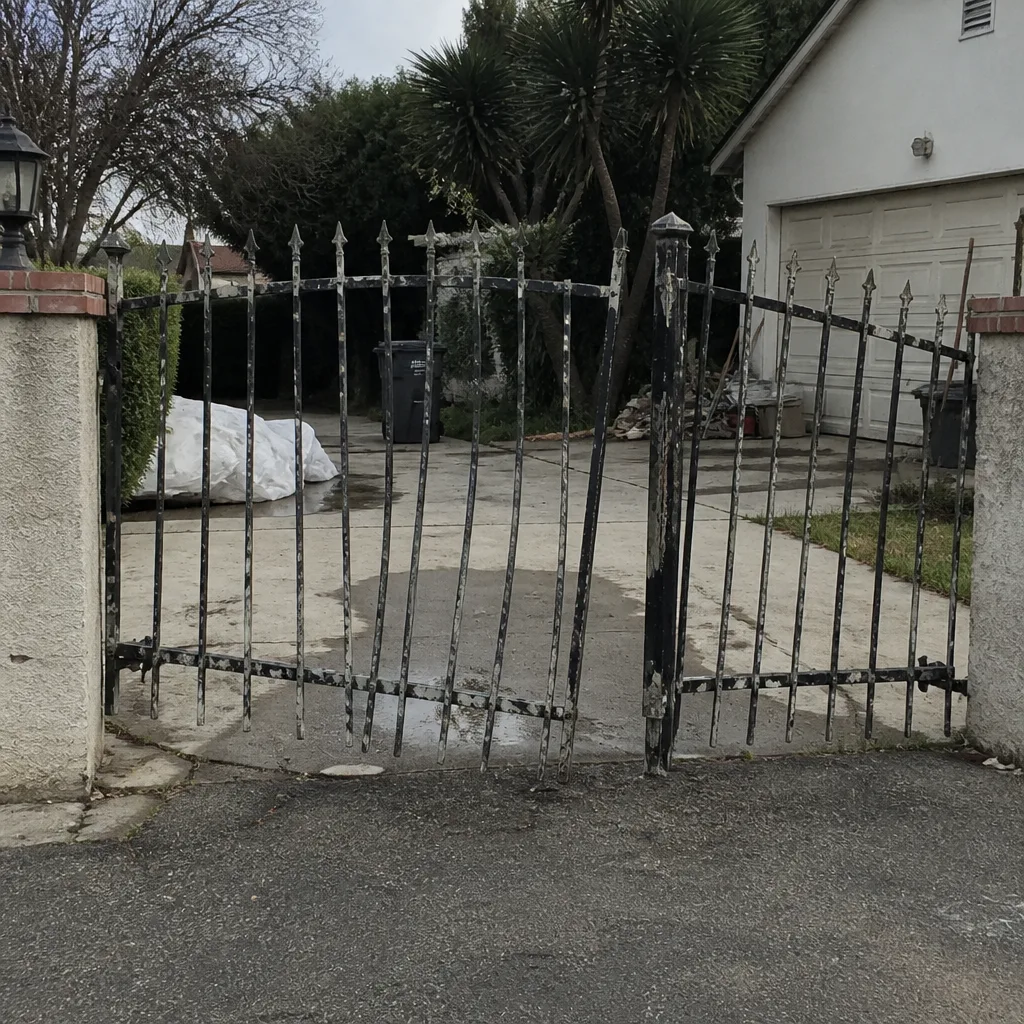
 Before
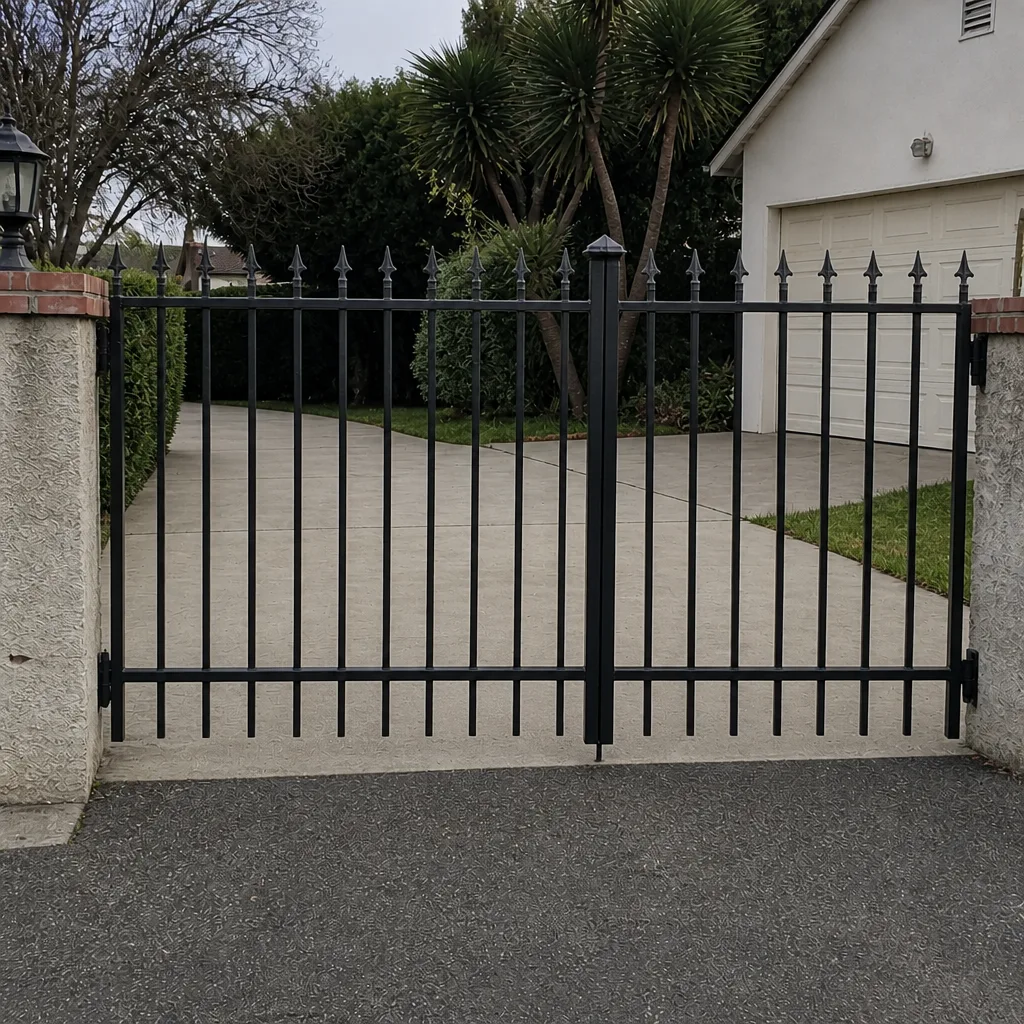
 After
 Before
 After
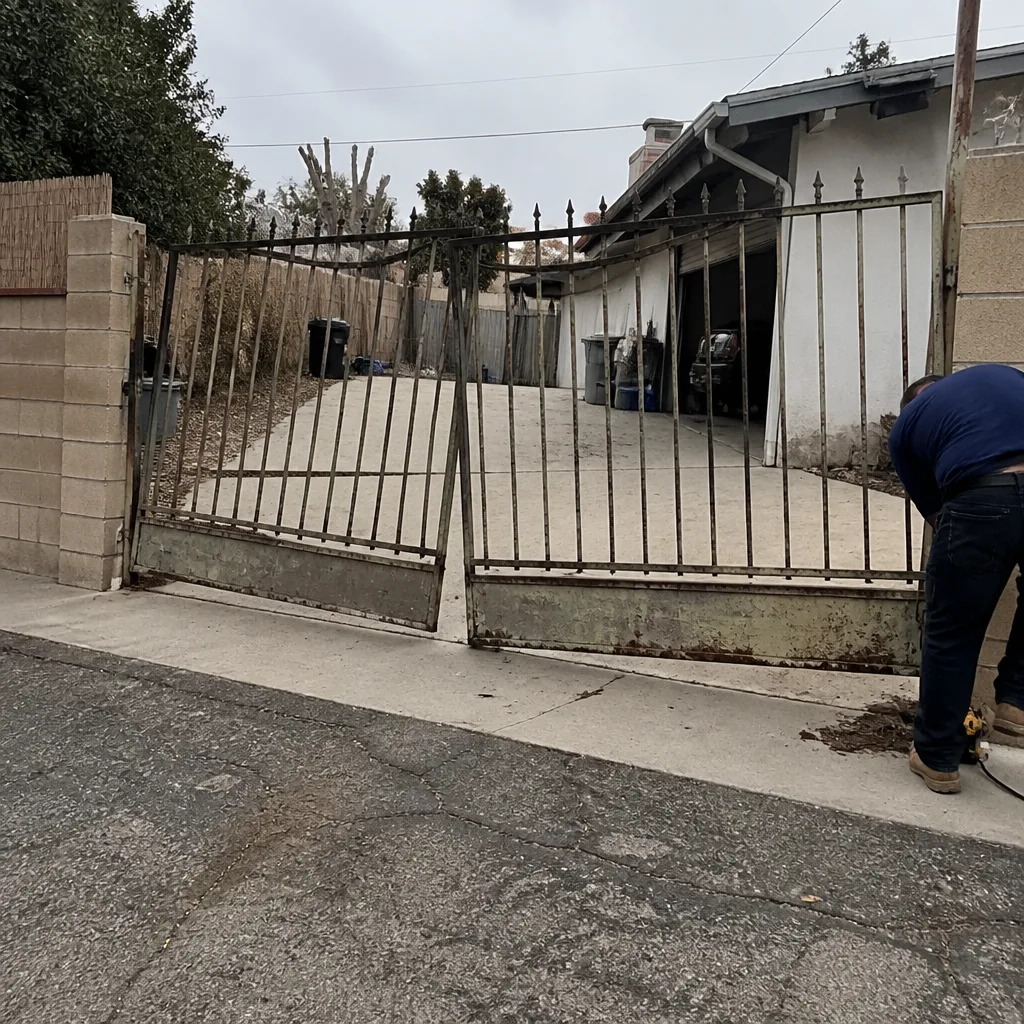 Before
 After
When to Call a Professional
Some maintenance tasks belong in your hands and some in ours. Anything that involves the operator housing, the control board, the wiring, the battery under load, or the safety devices belongs with a technician. So does anything that’s causing the gate to bind, sag, or reverse incorrectly. Gates are heavy and they move on their own; a panel that falls or a hinge that lets go can cause serious injury, which is why the mechanical and electrical tiers of the schedule are worth professional attention rather than owner adjustment. Our technicians have up to 13 years of experience, and we’re licensed and insured.
If you’re not sure whether something needs a visit, describe it when you call. We offer free estimates in Glendale, and we’ll tell you honestly whether it’s a service visit or a repair. Call (888) 853-9043. We answer 24/7. Fast dispatch from 7am to 7pm, Sunday through Friday.
Frequently Asked Questions
A residential gate should get monthly owner checks, quarterly mechanical service, and an annual electrical and safety inspection. In Glendale, add an inspection after each major wind event and pull roller and seal checks forward into summer, when heat does the most wear. The three-tier structure matters because different components fail on different clocks, and hitting them all on one visit means the safety items are always behind.
No. The annual electrical inspection is specifically for the problems that don’t show up in normal operation: a battery that’s lost capacity but still holds voltage, a photo-eye that’s drifted out of alignment, and a control board developing fatigue. Those issues tend to surface at the worst possible moment, usually during a power outage or a busy morning. Skipping the inspection saves nothing and costs more later.
A load test applies the operator’s actual current draw to the battery and checks that voltage holds within spec. A voltage check only confirms the battery is charged, not that it can deliver current under load. A gate that runs fine on mains power can still be completely dead during an outage if the battery has lost capacity, and the annual load test is what catches that. Call (888) 853-9043 for a free estimate on a gate inspection in Glendale.
That’s almost always loop detector drift or a photo-eye that’s out of calibration. The loop detector is sensitive to nearby metal and ground movement, and its baseline shifts over time, so it can start triggering on a car in the street rather than a car on the driveway. Photo-eye drift can produce a similar effect. Both need recalibration, which is part of the annual electrical inspection.
Santa Ana winds bring grit into tracks and chains, add side loads to panels, and stretch chains faster. Summer heat hardens rubber seals, deforms nylon rollers, and reduces solar panel output. Add a post-wind visual inspection, check rollers and seals in the spring and summer ahead of the heat, and clean solar panels at the start of the hot months. The local schedule should be your standard schedule plus those seasonal adjustments, not a different schedule entirely.
For lubrication and visual checks, a careful homeowner can handle the monthly tier. For quarterly mechanical service and the annual electrical and safety inspection, you want a gate specialist, because the loop detector, photo-eye, control board, and battery load test are gate-specific skills. General handymen often skip these, and when you call us in Glendale, the specialists diagnose and repair the actual brand installed. We work on DoorKing, Elite, Mighty Mule, LiftMaster, and the five other brands we service as a gate-only operation. Call (888) 853-9043 for a free estimate.
The Bottom Line
A gate maintenance schedule should mirror how a gate actually fails: monthly checks for what you can see, quarterly service for what moves, and an annual inspection for what you can’t see. In Glendale, add the Santa Ana wind adjustment and the summer heat adjustment on top of that base schedule, and keep a written log of every visit so the next diagnostic is fast. If you want a fresh start on your gate’s history, or just a professional look at what’s due, we serve the whole city and the surrounding area. Reach us through Glendale or call (888) 853-9043. We answer 24/7. Fast dispatch from 7am to 7pm, Sunday through Friday. Estimates are free and the price is agreed before any work starts.
Written by the team at Glendale Gate Repair.