
Last updated November 16, 2026
 Wrought iron
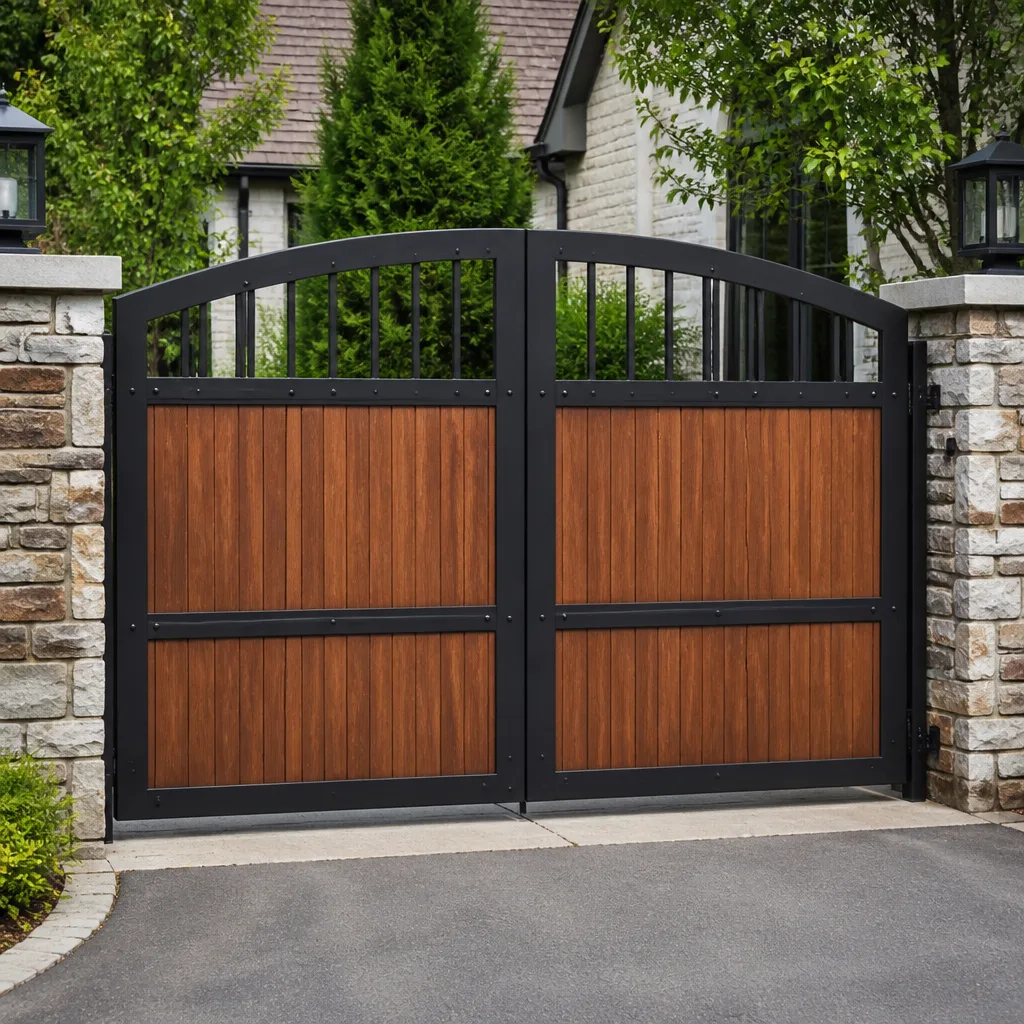 Wood & steel frame
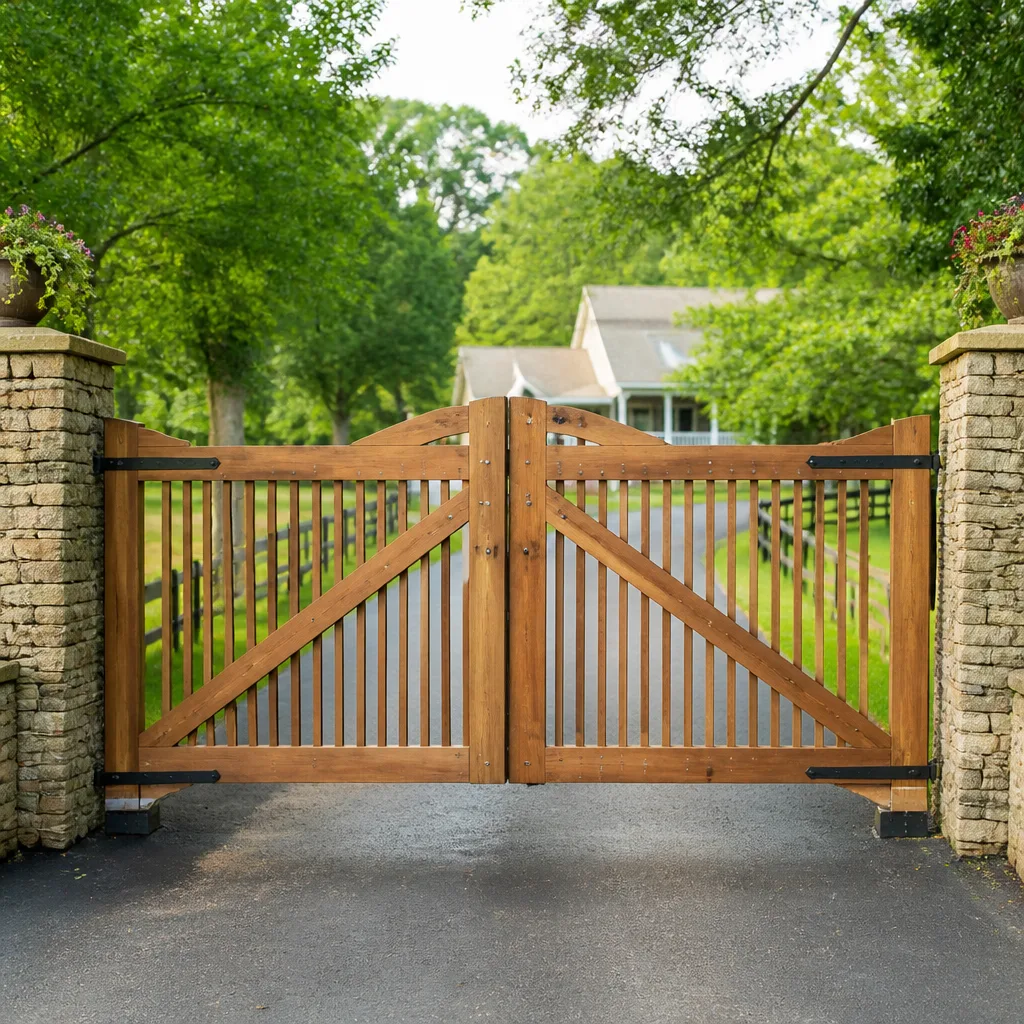 Farm & ranch
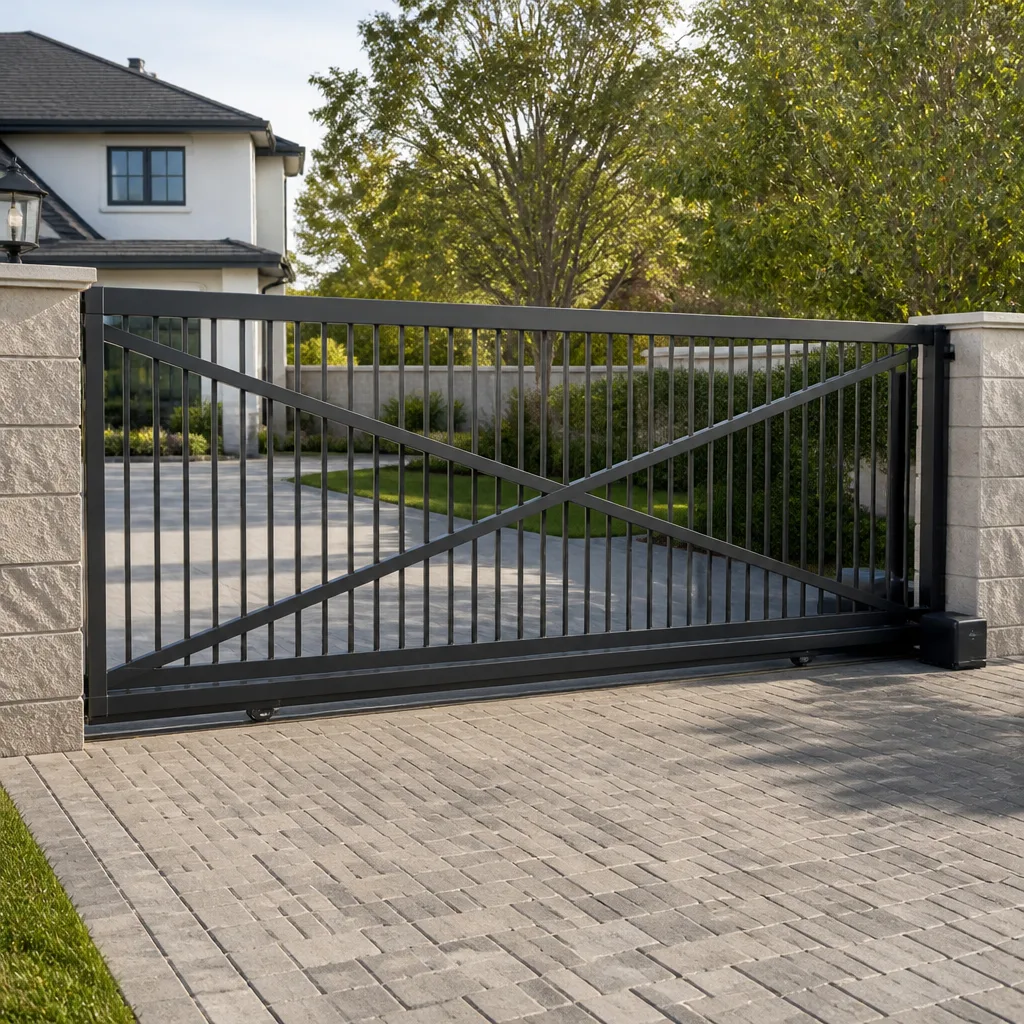 Sliding driveway gates
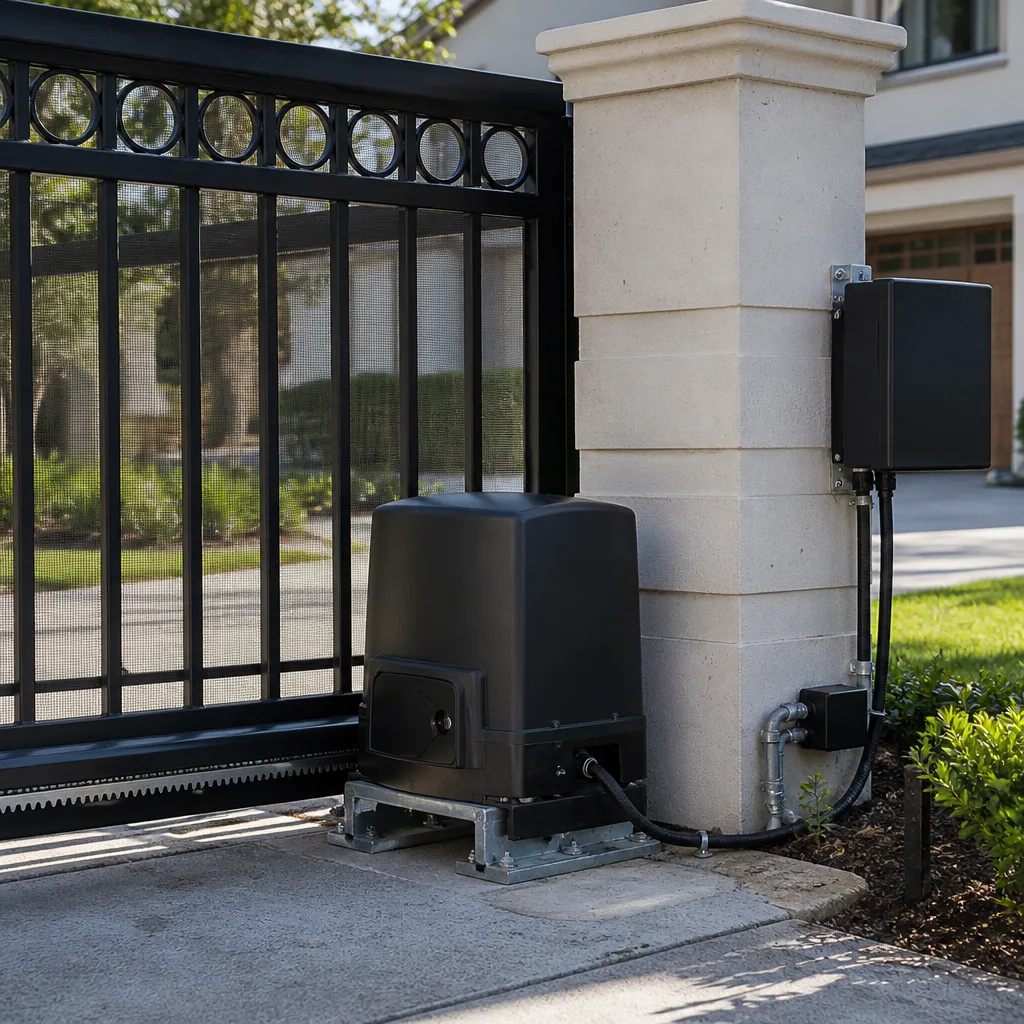 LiftMaster operators
Free on-site gate assessment - hinges, posts, and your LiftMaster or Nice gate operator checked before anything is quoted
The assessment is free and the quote is the invoice.
Get your free estimateGate Repair Warning Signs: A Glendale Homeowner’s Reference Guide
Most people assume a gate fails all at once. It doesn’t. Gates are among the most talkative pieces of equipment on a property – they grind, click, hum, hesitate, and stall for weeks or months before they finally give up. In our experience, the homeowners who learn to read those signals spend far less on repairs than the ones who wait for a total breakdown. A gate that’s been announcing a problem for a month usually needs a small, focused fix. The same gate ignored for a season often needs a motor, a control board, or a new carriage assembly. This guide walks through the sounds, the visual clues, and the behavioral changes that tell you what’s actually wrong, so you can catch a minor repair before it turns into a major one. We’ll focus on what we see in Glendale specifically, including the older estate properties that make up a big share of the local housing stock.
Quick Answer
A gate that grinds, clicks, hums without moving, hesitates, reverses partway, or lags on the remote is showing a warning sign that should be diagnosed before it becomes a full failure. On swing gates, most early warnings point to the operator, control board, or hinge wear; on sliding gates, most point to the track, rollers, or carriage arm. Grinding is usually debris or a worn roller, clicking is usually electrical or a failing relay, humming without motion is usually a stalled motor or a bound track, and silence after a command is usually power, remote, or control board. Catching these early usually keeps a repair small. Waiting turns a component swap into a mechanical replacement.
Styles & brands we work with
- Wrought iron
- Wood & steel frame
- Farm & ranch
- Sliding driveway gates
- LiftMaster operators
Table of Contents
- Sound-Based Warning Signs: What Your Gate Is Telling You
- Visual Warning Signs Beyond the Obvious
- Behavioral Warning Signs in Automated Gates
- Warning Signs Specific to Glendale’s Older Estate Gates
- Severity Triage: When to Schedule Service vs. Call Tonight
- Brand-Specific Behavior: What Viking, Ghost Controls, DoorKing and Elite Owners Notice First
- Seasonal Patterns in Glendale and What to Check Monthly
- Common Mistakes to Avoid
Sound-Based Warning Signs: What Your Gate Is Telling You
A gate’s sound is its most reliable diagnostic signal, and it’s the one most homeowners tune out. The key is learning to separate a sound that means “clean and lubricate” from a sound that means “stop and call.” On a sliding gate, grinding usually points to a debris-packed track or a worn roller – a low-cost fix if caught early, a bent carriage arm if ignored. On a swing gate, grinding more often means hinge wear or the operator arm binding against its mount. The two mechanisms sound similar but fail differently, so the first question we ask every Glendale caller is whether their gate slides or swings.
Here’s how to interpret the four sounds you’re most likely to hear:
- Grinding: On a sliding gate, a track packed with dirt, leaves, or gravel, or a roller that’s worn flat. On a swing gate, dry or worn hinges, or the operator arm scraping its mount. Rarely electrical.
- Clicking: Usually electrical. On an automated gate, clicking at the operator can mean a failing relay, a control board struggling to send power, or a limit switch that’s out of adjustment. Clicking that repeats without motion is a control system signal, not a mechanical one.
- Humming without movement: The motor is receiving power but the gate isn’t moving. On a sliding gate this can mean the carriage is bound on the track or a wheel has jumped. On a swing gate it can mean the operator arm is jammed or the gate is physically blocked. This is a “stop using it” signal, not a “keep pressing the remote” one.
- Complete silence after a command: The operator isn’t getting power, the remote isn’t transmitting, the safety loop isn’t detecting, or the control board has failed. Silence is the hardest to self-diagnose, which is why it’s the most common reason for a diagnostic visit.
The single most useful habit is this: stand outside your gate and listen to a full open-and-close cycle once a month. You’ll learn what “normal” sounds like for your specific gate, and any change will stand out immediately. A sound you’ve never heard before is worth a phone call. A sound that’s been there for months and hasn’t changed is also worth a call, because it’s not going to fix itself.
If you’re hearing something you can’t place, electric gate repair starts with a diagnostic visit rather than a guess over the phone.
Visual Warning Signs Beyond the Obvious
Most people know to look for a bent gate or a broken hinge. The warning signs that actually predict failure are subtler, and some of them look cosmetic when they’re anything but.
Start with the posts. Paint bubbling or flaking at the base of a gate post is often read as ordinary weathering. In practice, bubbling paint at a post base is one of the most reliable early signs of water intrusion. Moisture gets behind the coating, works into the metal or the concrete footing, and starts corrosion from the inside. By the time the bubbling is visible, the metal is usually already compromised. On a swing gate, that means the post itself may be losing the rigidity that keeps the gate hanging true. On a sliding gate, a post that’s moved slightly will throw the track out of alignment and start the grinding cycle described above.
Other visual signs worth a look every few months:
- Cracks in the concrete footing around the post or the track. Small cracks let water in and allow the footing to shift, especially after heavy rain. A footing that’s moved even slightly will change how the gate tracks.
- Rust streaks down the gate frame or at the operator mount. A single streak is cosmetic; multiple streaks clustered at a joint usually means a fastener is loose and water is getting into the seam.
- Track debris on a sliding gate. Leaves, seed pods, small gravel, and dirt pack the track over time. A visible buildup is a grinding repair waiting to happen.
- Sagging gate leaf on a swing gate. Usually hinge wear or a post that’s shifted. A sagging gate puts extra load on the operator arm and shortens the motor’s life.
- Frayed or exposed low-voltage wire running to the operator. Rodents, digging, and simple wear expose wiring that should be protected. Never handle exposed wiring yourself – it’s a job for a technician.
- Discoloration or burn marks at the control board box. Any sign of heat at the electrical enclosure is a stop-and-call signal.
None of these require an emergency visit on their own, but each is worth noting and mentioning when you book. Water intrusion at the post base and a shifted footing are the two visual signs most likely to turn into structural repairs if left alone.
Behavioral Warning Signs in Automated Gates
Automated gates fail in patterns. Before a motor dies, before a control board fails, the gate usually starts behaving oddly. These are the signals that live in the operator and the control system, and they’re the ones general repair services often turn away because they don’t work on gate automation specifically.
Watch for these four behaviors:
- Hesitation at the start of a cycle. The gate pauses for a second or two before it begins to move. On most systems this points to a control board that’s taking longer to process the command, a low battery in the operator backup, or a safety sensor that’s borderline registering. It’s usually caught and fixed early.
- Partial reversal mid-cycle. The gate begins to close, then reverses and opens again without an obvious obstruction. This is almost always a safety sensor or a loop detector issue – the gate thinks it sees an obstacle. It can also mean the control board is misreading a limit switch. Either way, don’t ignore it; a gate that reverses unpredictably is a real hazard to vehicles and people.
- Remote lag or reduced range. The remote needs to be closer to the gate, or the gate responds only on the second or third press. Usually a battery in the remote, sometimes a receiver that’s degraded, occasionally interference. If you’ve changed the remote battery and the lag remains, the receiver is the next suspect.
- Slower cycle times. The gate opens and closes more slowly than it used to. On many systems this is a low-power signal – the operator is drawing more current because something is binding, or the internal battery backup is fading. A slow gate is often a motor under strain.
Each of these behaviors points to a specific part of the control system. Our technicians work with LiftMaster, FAAC, BFT, Linear, Viking, Ghost Controls, DoorKing, Elite, and Mighty Mule, so we diagnose the brand that’s actually installed rather than working around it. If your automated gate is hesitating, reversing, or lagging in Glendale, a diagnostic visit usually resolves in one trip – gate repair on an automated system should start with the control logic, not the hinge.
Warning Signs Specific to Glendale’s Older Estate Gates
Glendale has a lot of housing stock from the 1980s and 1990s, and a meaningful share of that stock includes original gate systems still in service. An automated gate installed thirty or more years ago has different failure patterns than one installed in the last few years, and the warning signs are worth learning if your property is in that age range.
The most common signs on legacy systems:
- Wiring aging out before the hardware does. Original low-voltage wiring to the operator, and the conduit it runs in, breaks down over decades. On a 30-year-old installation, the gate itself may be solid while the wiring is failing. Symptoms show up as intermittent commands, dead zones in the control loop, or a remote that only works from certain angles.
- Limit switches drifting out of adjustment. Older limit switches are mechanical, and over time they go slightly out of position. The gate starts stopping short, over-travelling, or reversing at random points in the cycle. This is a small fix that becomes a large one if the gate keeps over-driving the mechanism.
- Operator housing corrosion and seal failure. Decades of rain and dust work into the operator housing. When the seals fail, water gets to the motor and circuit board. Signs include rust at the housing seams and a control board that misbehaves after rain.
- Footing settlement on older posts. A 30-year-old concrete footing has seen many soil cycles. When it shifts, the track (on sliders) or the hinge line (on swings) moves with it. The gate starts grinding or sagging even though the operator is fine.
- Unavailable replacement parts on very old systems. Some legacy operators no longer have current replacement parts. That doesn’t mean the gate has to be replaced – sometimes the operator can be upgraded to a current unit from the same brand family – but it does mean diagnosing early is more valuable on legacy systems than on newer ones, because options narrow as failures progress.
If your gate has been in service since the 1980s or 1990s and hasn’t been diagnosed in years, a single preventive visit almost always pays for itself by catching one or two of these before they compound. In Glendale, the combination of aging infrastructure and the hot inland valley climate – which we’ll cover below – accelerates all five of these failure modes.
Severity Triage: When to Schedule Service vs. Call Tonight
The most useful thing a homeowner can do with this guide is learn to sort warning signs by urgency. Not every sign is an emergency, and calling everything a crisis wastes money and makes it harder to schedule. Here’s how we sort them when a Glendale homeowner calls.
Schedule service this week:
- Grinding, squeaking, or scraping that’s consistent but not worsening.
- Slow cycle times.
- Remote lag that a fresh remote battery doesn’t fix.
- Recent paint bubbling at the post base, or rust streaks at a joint.
- Occasional hesitation at the start of a cycle.
- Visible track debris or a slightly sagging gate leaf on a swing gate.
Call today – this is not a wait-and-see:
- Humming without movement. The motor is under load and continuing to try to run will damage it or the mechanism.
- Partial reversal mid-cycle without a visible obstruction. This is a safety hazard to vehicles, pets, and people.
- A gate that has stopped responding entirely, with power confirmed at the breaker.
- Visible damage to the control board enclosure, including burn marks or discoloration.
- Any sign of a gate that’s come off its track or is riding at an angle on a sliding system.
- Exposed wiring, whether at the operator or along the wire run to the gate.
Emergency – call tonight:
- The gate is physically stuck partway open or partway closed and can’t be manually moved. A gate stuck open is a security problem; a gate stuck closed traps vehicles inside.
- The gate has come off the track, is leaning, or is partially collapsed. This is a crushing hazard on heavy panels and should never be handled by hand.
- Smoke, burning smell, or visible sparking from the operator or control box. Turn power off at the breaker and call.
- A gate that’s moving on its own and won’t stop. This is a control board failure and a genuine danger.
On a gate, the dangerous components are not springs – those don’t exist on a gate. The risks are the operator’s electrical supply, the weight of the panels themselves, and slide gates that come off their track. Never try to force a heavy gate back onto its track alone, never open an operator housing or a control board enclosure yourself, and never troubleshoot live wiring. That work belongs with a trained technician, and it’s part of why we’re Glendale Gate Repair specialists rather than a general handyman visit.
Brand-Specific Behavior: What Viking, Ghost Controls, DoorKing and Elite Owners Notice First
Different operators fail in slightly different ways. Knowing what your brand tends to do first helps you describe the problem clearly when you call – and helps a technician bring the right parts on the first visit.
On a Viking operator, the most common first sign of an aging system is a slow-down at the end of the close cycle. Viking operators usually give a warning before a limit issue becomes a hard stop, so a gate that’s gradually closing more slowly is often catching the problem early.
On Ghost Controls systems, the first sign is usually remote or app behavior – a remote that needs a closer range, or a delayed response to a command. Ghost Controls is a residential-grade system, and its weak points tend to be at the receiver and battery side rather than the motor.
On a DoorKing system, the first sign is usually at the access control layer – a keypad that intermittently doesn’t register, a loop detector that fails to detect a vehicle, or an entry code that works one day and not the next. DoorKing is a professional-tier system, often found on small commercial Glendale properties, and access-control symptoms tend to show up before the operator itself struggles.
On an Elite operator, hesitation at the start of a cycle and inconsistent limit stops are the most frequent early indicators. Elite systems are common on mid-range residential installs, and the control board’s processing behavior usually gives you a warning before a hard failure.
We work on all nine brands we cover – including commercial-grade systems like FAAC, BFT, and DoorKing, and residential brands like Mighty Mule and Ghost Controls – so the diagnosis starts from the actual brand installed, not a guess. If your gate behaves in one of these patterns and you’re not sure which brand it is, check the operator housing; the label is usually on the side. You can also Glendale homeowners can call us and we’ll walk through identification on the phone.
Seasonal Patterns in Glendale and What to Check Monthly
Glendale sits in a hot inland valley, and the local climate has a measurable effect on gate systems. Summers are hot and dry, winters are mild but wet, and the swing between the two accelerates a few specific failure modes.
Heat and dust do most of the work here. Dry summers dry out grease and lubricant on tracks, rollers, and hinges faster than in cooler climates. A gate that was properly lubricated in spring may be running dry by late summer, which is when grinding sounds start appearing. Dust and grit build up in tracks and around hinge pins more quickly in a dry climate, so sliding gates in Glendale need more frequent track cleaning than the manufacturer’s general guidance suggests. On the wiring side, the same heat that dries lubricant also stresses wire insulation and operator housing seals, which is why we see more low-voltage wiring failures on older Glendale systems than the hardware itself would suggest.
Winter is mild but not dry. Rain gets into post bases, footings, and operator housings, and the freeze-thaw cycle that affects colder regions isn’t the issue here – it’s water intrusion followed by mild days that let corrosion progress. Paint bubbling at the post base, rust at housing seams, and a control board that misbehaves after rain are all winter-and-spring signals in Glendale.
A brief monthly check catches most of this:
- Listen to one full open-and-close cycle and note any new sound.
- Look at the post bases for bubbling paint or new cracks in the footing.
- On a sliding gate, clear visible debris from the track.
- Test the remote from your normal distance and note any lag.
- Watch the gate’s behavior at the close cycle – hesitation, slowdown, or reversal.
- After any significant rain, look for new rust streaks or control box symptoms.
Two or three minutes a month is enough to catch most of the warnings in this guide before they escalate. If something’s changed, a free estimate visit is the fastest way to sort it out – electric gate repair and manual gate work both start there.
Common Mistakes to Avoid
- Treating grinding as a motor problem. It’s almost never the motor on a sliding gate. It’s usually the track or a roller, and continuing to run the gate makes it worse. In Glendale’s dry climate, lubricant dries out faster than most homeowners expect, and grinding starts before they’ve thought about maintenance.
- Pressing the remote again and again when the gate hums without moving. Each press sends full power to a stalled motor. That’s how a repair that started as a track clean becomes a motor replacement.
- Ignoring paint bubbling at the post base as cosmetic. It’s not. It’s water intrusion, and by the time the paint bubbles the metal underneath is usually already compromised.
- Overriding a reversing gate by propping it open. A gate that reverses unpredictably is a safety sensor or control logic problem. Propping it open treats the symptom and leaves the underlying fault.
- Calling a general handyman for an automated gate. Motors, control boards, loop detectors, and access control are a specific discipline, and many general repair services will turn the job away. The diag visit ends up costing more because the first technician can’t finish the job.
- Waiting until the gate stops completely before booking. On older Glendale estate systems especially, the gap between “warning sign” and “hard failure” is when repair parts are still easy to source. Once the gate seizes, options narrow.
- Not mentioning the brand when you call. A technician working on a DoorKing access system brings different parts than one working on a Mighty Mule residential opener. Knowing the brand upfront usually means one trip instead of two.
See the difference
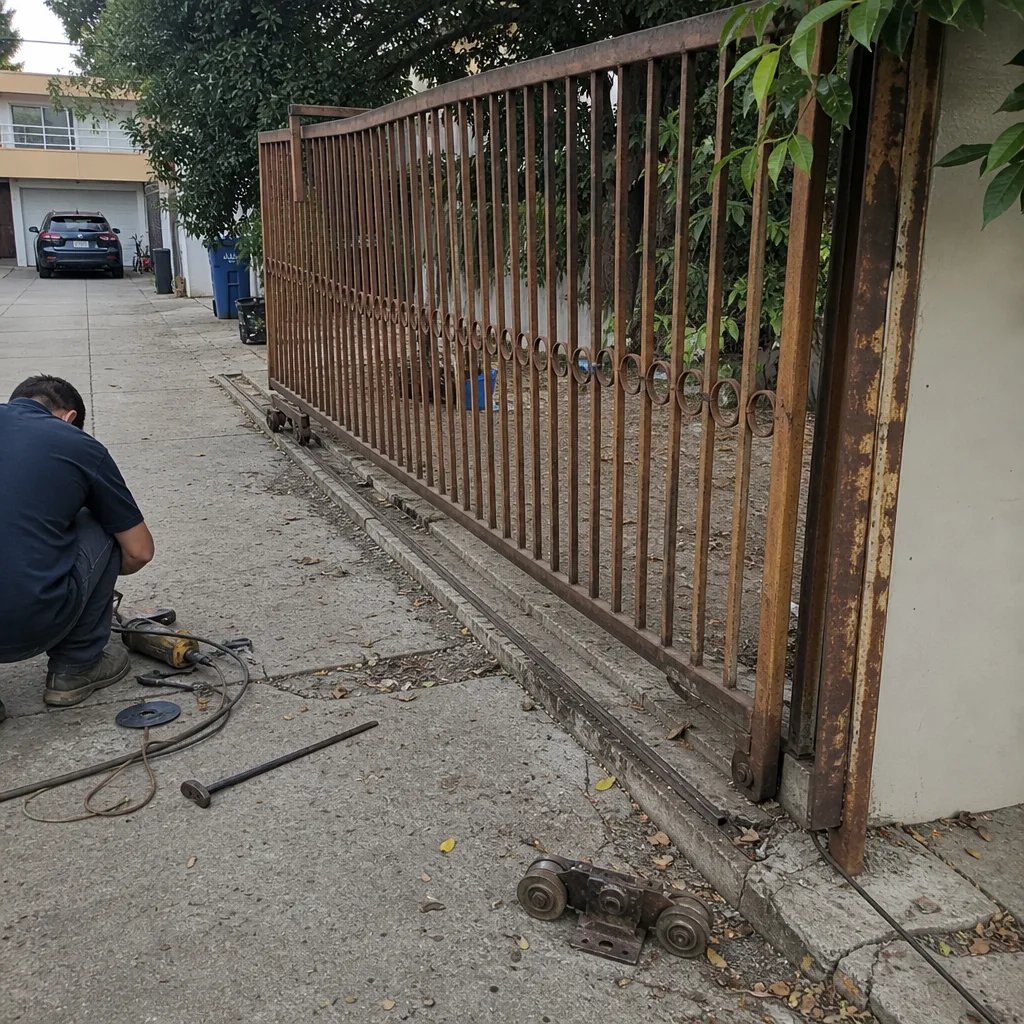 Before
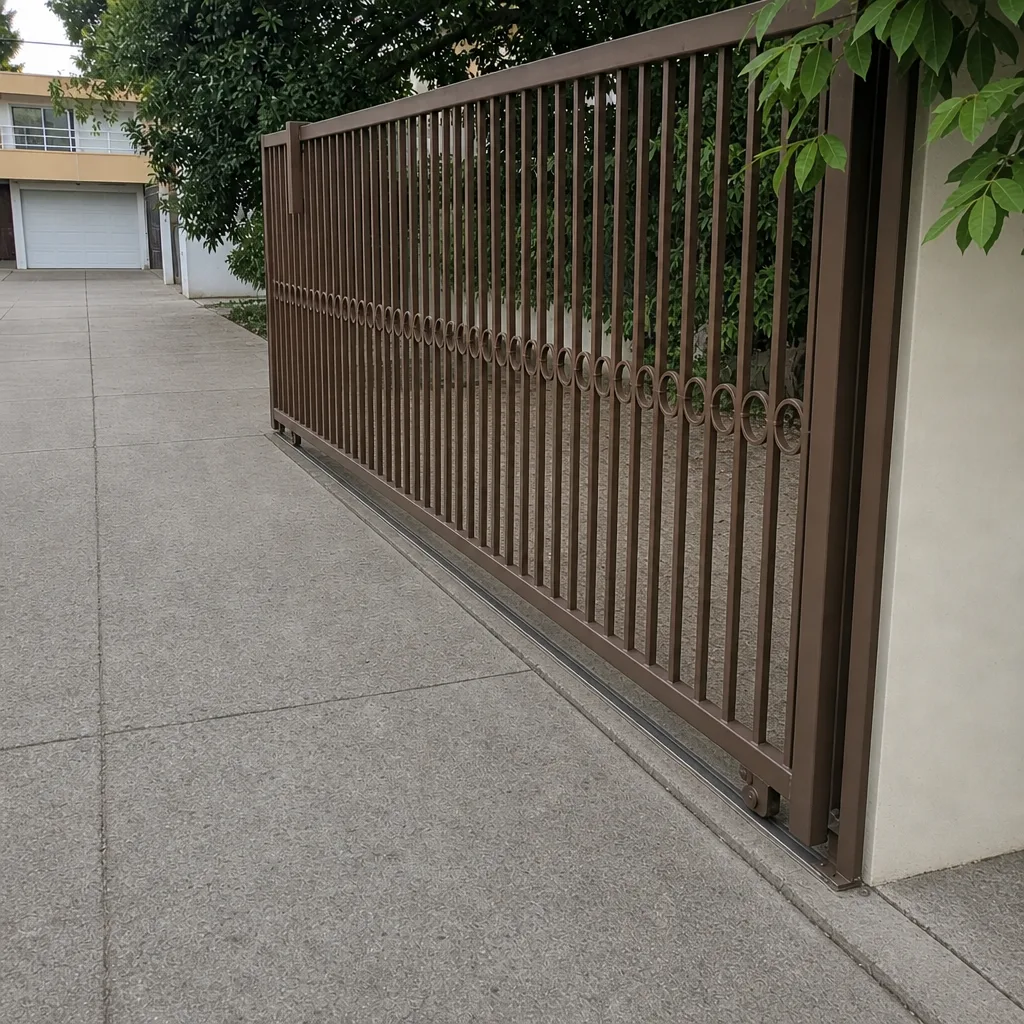 After
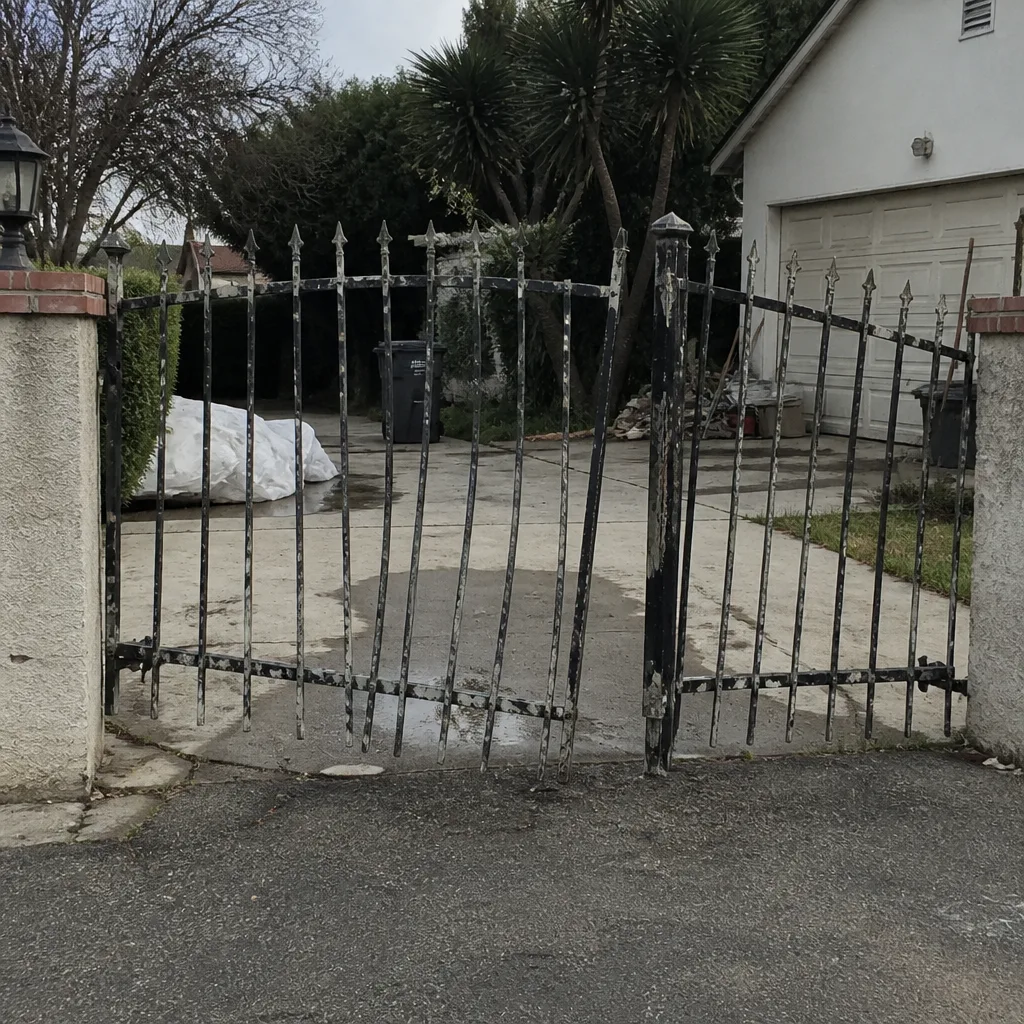 Before
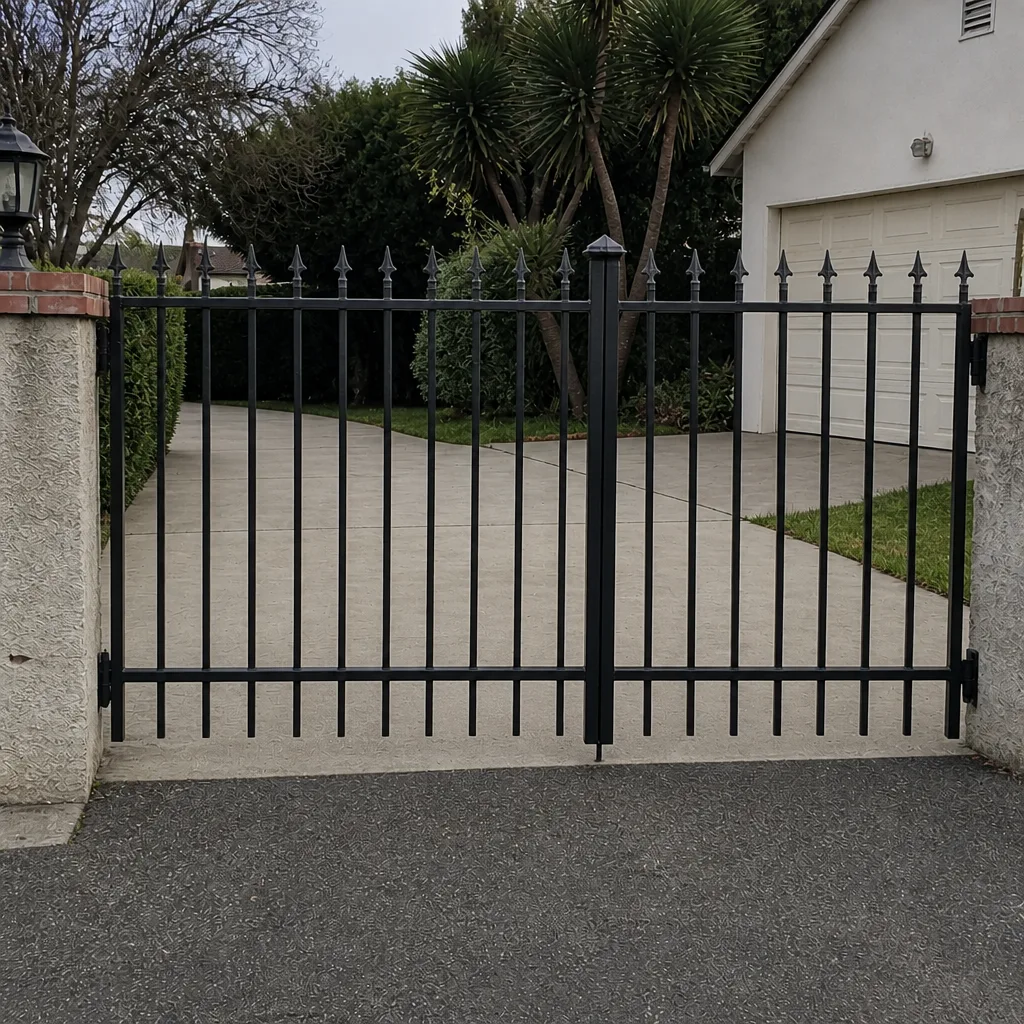 After
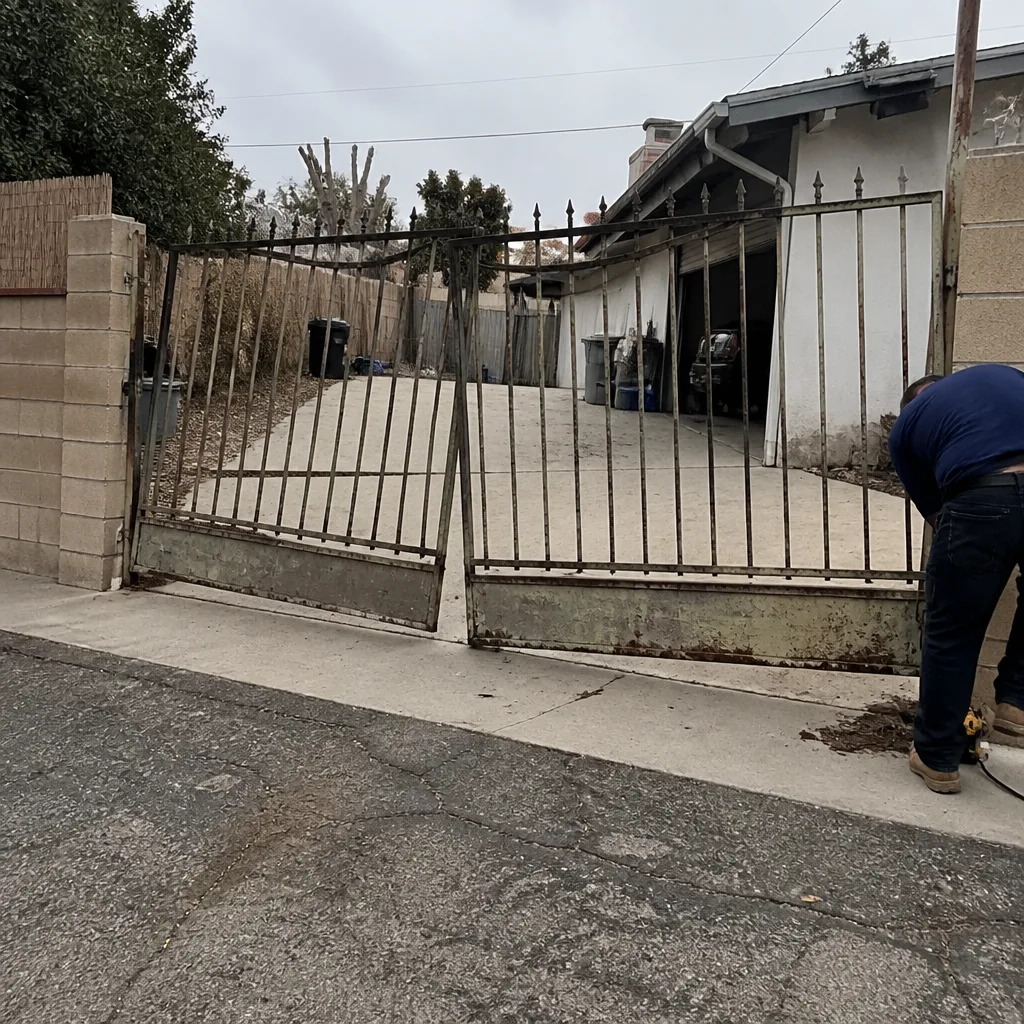 Before
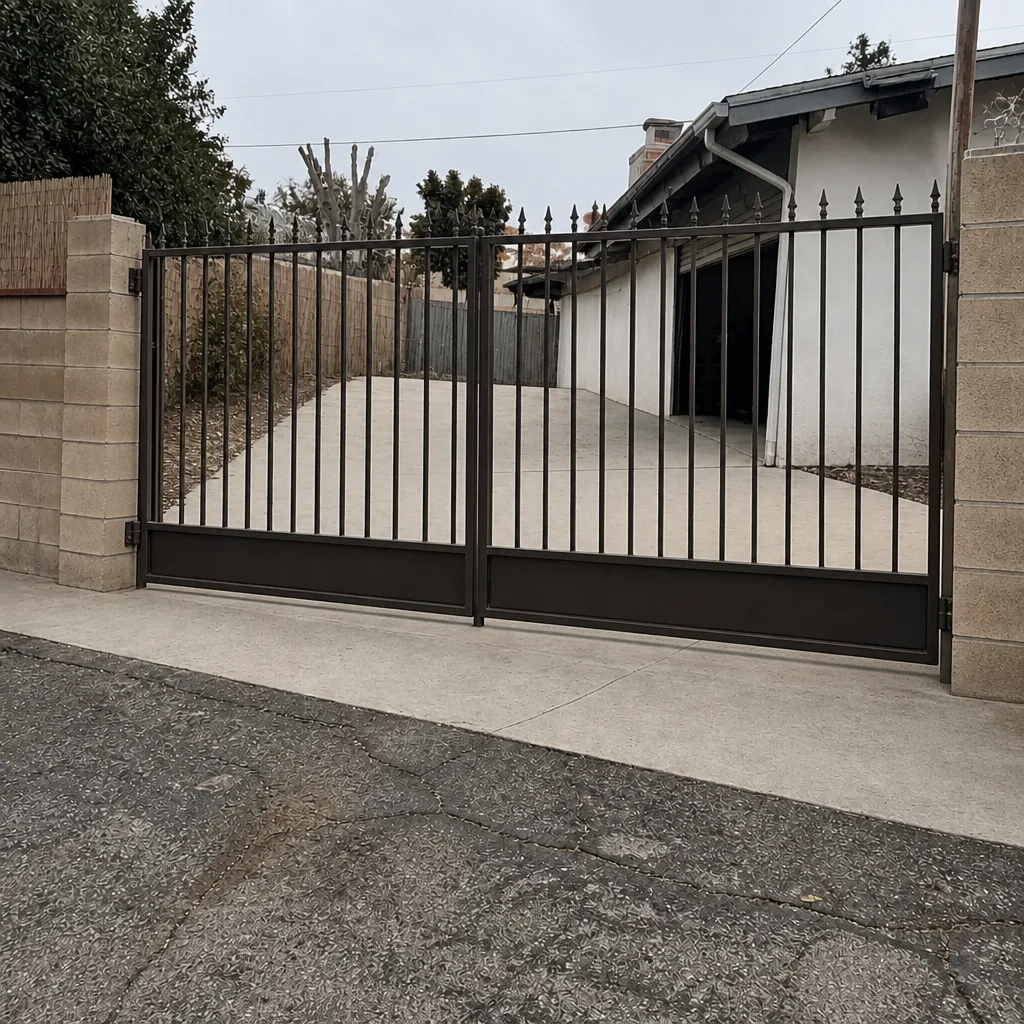 After
When to Call a Professional
Call a professional when the gate hums without moving, reverses unpredictably, stops responding entirely, or shows any electrical warning – burn marks, a hot smell, or exposed wiring. Turn the breaker off first if you smell burning, then call. Call for grinding that hasn’t resolved after a track clean, for a gate that’s come off its track or is riding at an angle, and for paint bubbling at the post base with a footing crack beneath it. Call if the gate is stuck partway open or partway closed and can’t be safely moved by hand. Call if the operator is more than twenty years old and has never been diagnosed – the visit is preventive, and it almost always catches something. And call if you simply don’t know what a sound or behavior means. Glendale Gate Repair offers free estimates in Glendale – call (888) 853-9043. The price is quoted and agreed before any work starts, so you’ll know the number before the technician picks up a tool.
Frequently Asked Questions
Grinding on a sliding gate and hesitation on a swing gate are the two most common early warnings. Grinding usually means a debris-packed track or a worn roller, not a motor problem, and hesitation usually means the control board or a safety sensor. Both are worth a diagnostic visit rather than a wait-and-see. Call (888) 853-9043 for an exact quote – estimates are free.
We can usually narrow it to a class of problem over the phone, especially if you describe the brand, whether the gate slides or swings, and the specific sound or behavior. We can’t confirm the exact part until we’re on site, which is why the first visit is a diagnostic visit. Call (888) 853-9043 and we’ll book a free estimate.
A humming gate is receiving power but the mechanism is bound or blocked. On a sliding gate that’s usually the carriage stuck on the track or a wheel off its rail; on a swing gate it’s usually the operator arm jammed or the gate physically obstructed. Stop pressing the remote and call, because each attempt stresses the motor. Call (888) 853-9043 for a same-day diagnostic where availability allows.
A gate that reverses mid-cycle is reading an obstacle that may not be there. The cause is almost always a safety sensor, a loop detector, or a control board misreading a limit switch. This is a safety issue, not a convenience one, and it shouldn’t be left to resolve. Call (888) 853-9043 – estimates are free and the visit can usually confirm the cause in one trip.
Most 1980s gates are worth repairing, and the operator is usually the piece that needs attention rather than the gate itself. On legacy systems, wiring, limit switches, and operator seals tend to fail before the gate structure does, and those are all fixable. When the operator is beyond economic repair, an upgrade to a current unit from the same brand family is often the right call, so the gate stays and the automation gets modernized. We’ll tell you honestly which one makes sense after a diagnostic visit. Call (888) 853-9043.
In most cases, yes. We service LiftMaster, FAAC, BFT, Linear, Viking, Ghost Controls, DoorKing, Elite, and Mighty Mule, covering both residential-grade and commercial-grade systems. If you’re not sure of your brand, check the label on the operator housing or call (888) 853-9043 and we’ll help identify it.
We answer 24/7, and we dispatch for same-day visits when availability allows. Fast dispatch from 7am to 7pm, Sunday through Friday. A call outside dispatch hours is booked into the next opening. Call (888) 853-9043 to book a free estimate.
An intermittent grind is still a warning sign – it usually means a track that’s starting to bind or a roller that’s wearing unevenly, and it’ll get more frequent before it fails. Catching it at the intermittent stage is when the repair is smallest. Call (888) 853-9043 for a free estimate and we’ll confirm.
The Bottom Line
Gates announce their problems long before they fail. Grinding is almost always track or rollers, not the motor. Humming without motion means the motor is stalled and every extra press adds damage. Partial reversal, hesitation, and remote lag are control-system signals, not quirks. Paint bubbling at the post base is water intrusion, not cosmetic wear. On Glendale’s older estate systems, wiring and operator seals fail before the gate structure does, and catching them early keeps the repair small. The triage is simple: grinding and slowdowns can wait for the week, humming and reversal should be same-day, and anything electric, stuck, or off-track is a call tonight. When in doubt, a free estimate beats a guess.
Need a technician to look at your gate? Call Glendale Gate Repair at (888) 853-9043 for a free estimate. We answer 24/7. Fast dispatch from 7am to 7pm, Sunday through Friday. We work on the brand you already have, from Viking and Ghost Controls to DoorKing and Elite, and we’ll give you a written price before any work starts.
Written by the team at Glendale Gate Repair.