
Last updated November 16, 2026
 Wrought iron
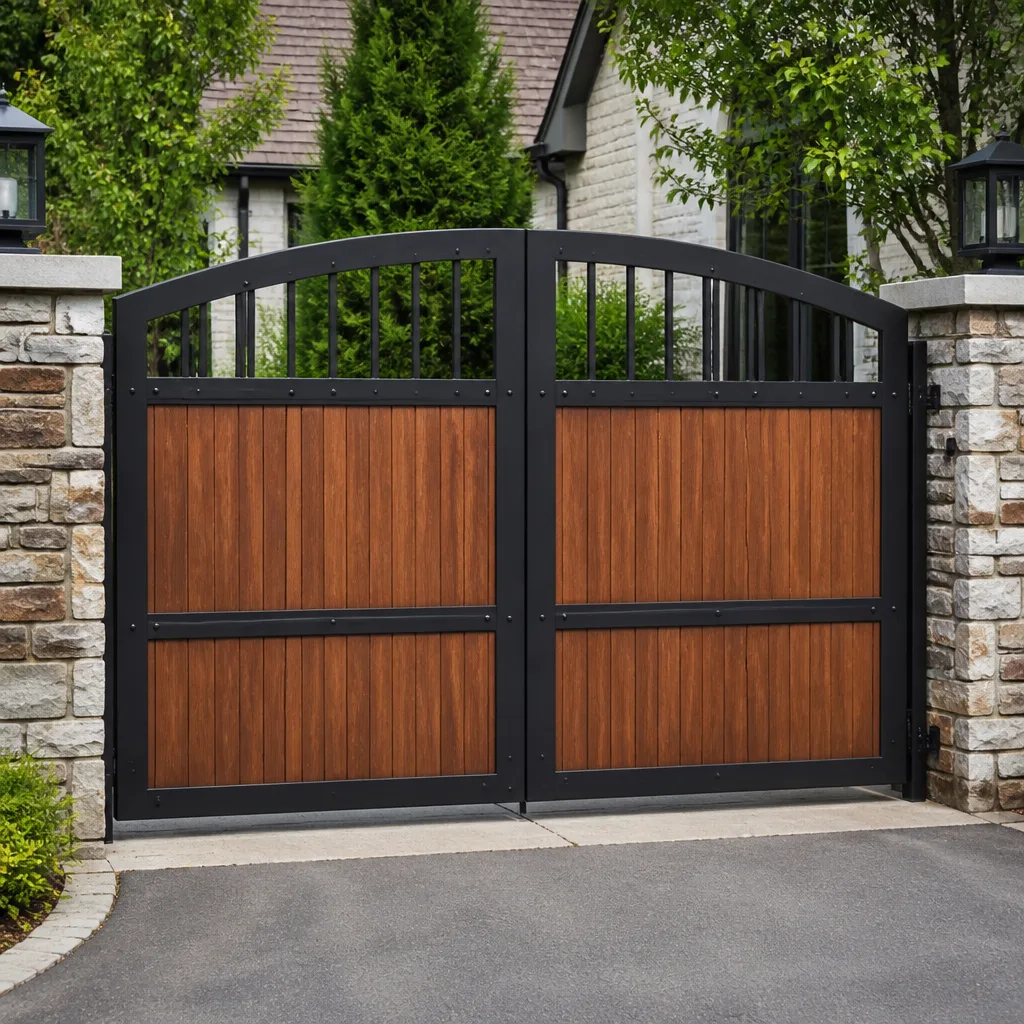 Wood & steel frame
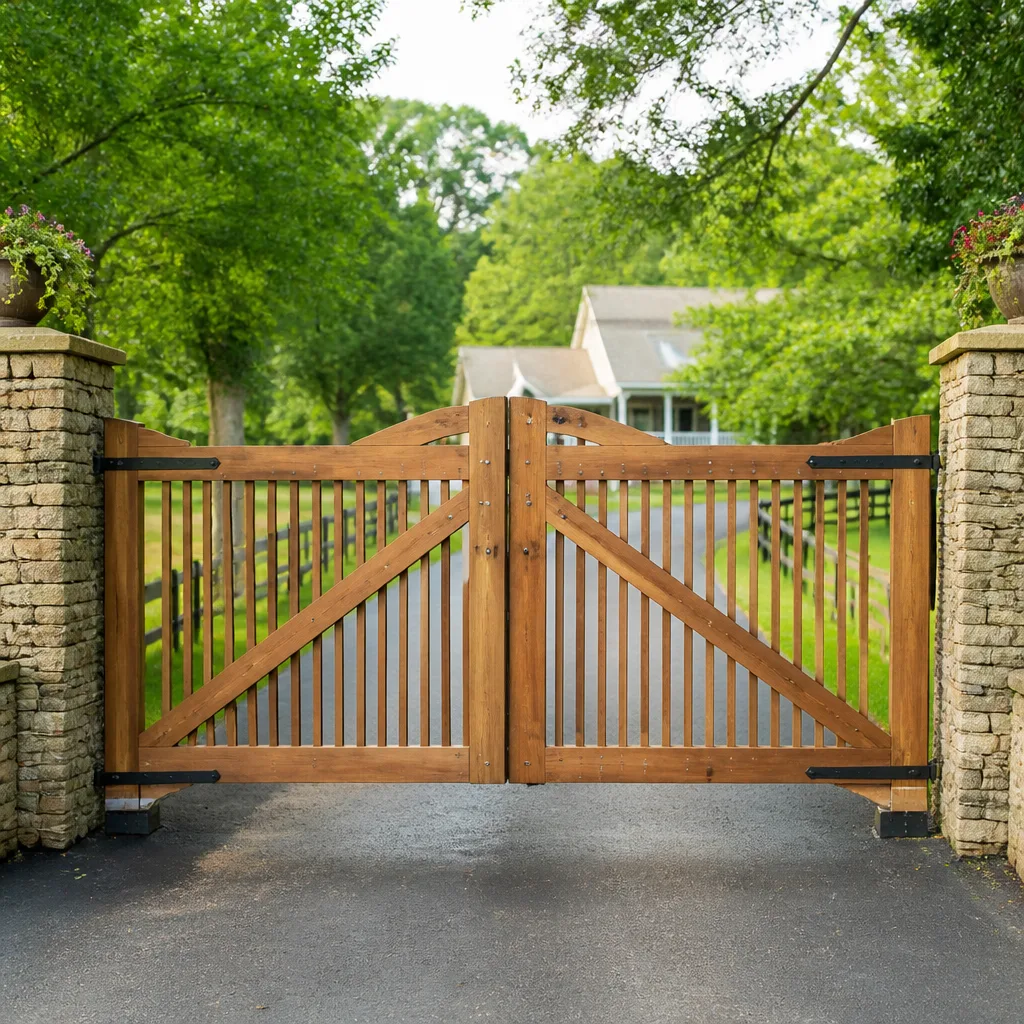 Farm & ranch
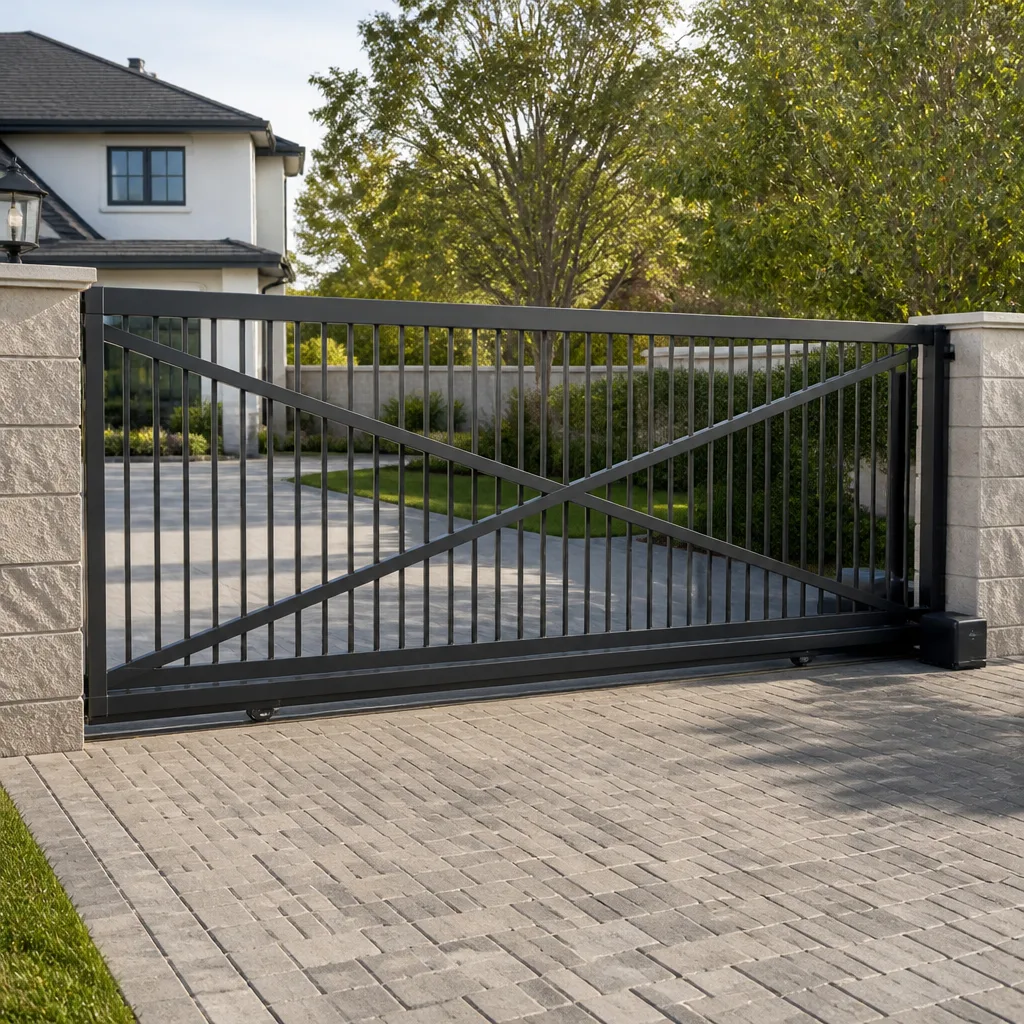 Sliding driveway gates
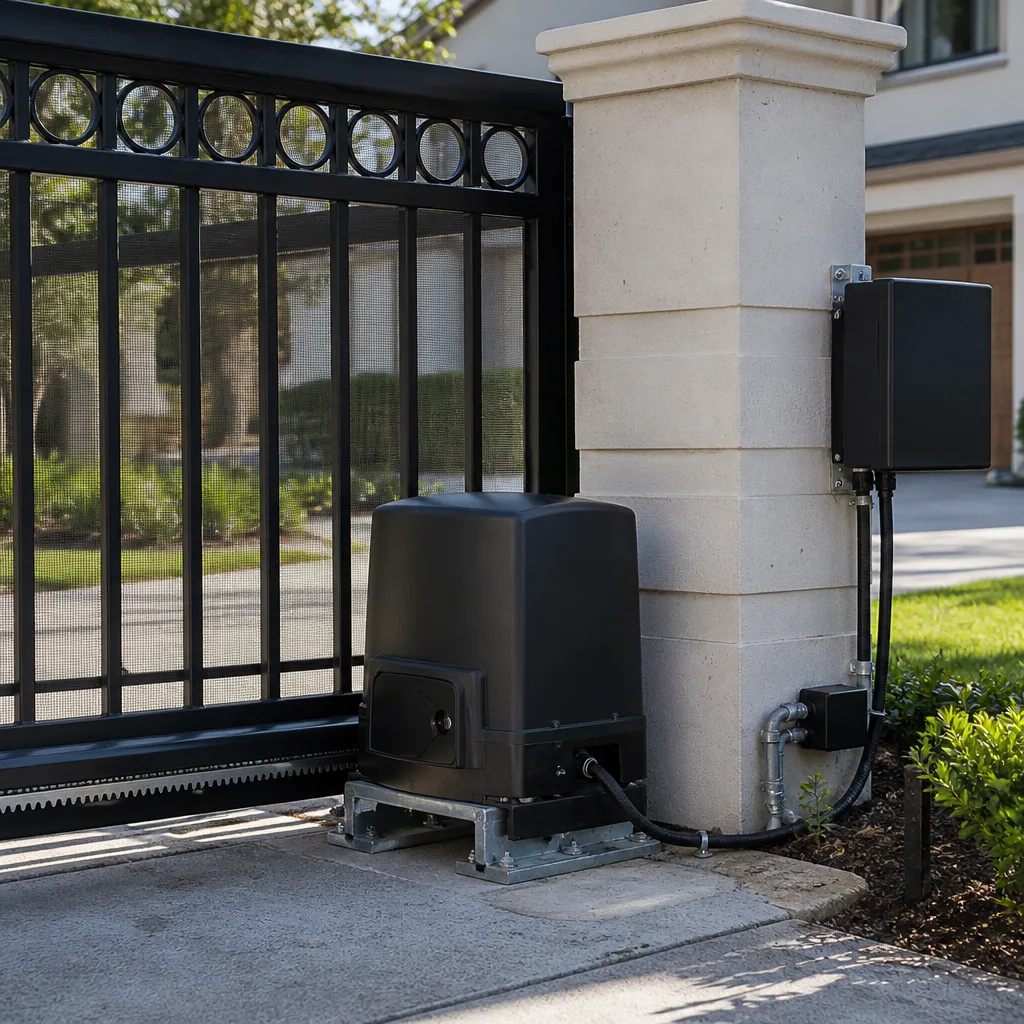 LiftMaster operators
Free on-site gate assessment - hinges, posts, and your LiftMaster or Nice gate operator checked before anything is quoted
The assessment is free and the quote is the invoice.
Get your free estimateThe Complete Guide to Gate Repair in Glendale
A gate that stops mid-swing isn’t necessarily a motor problem. It could be a limit switch that’s drifted out of adjustment, a loop detector that’s lost its tune, or a hinge that’s shifted a few millimeters and bound the whole swing. Get that diagnosis wrong and you replace parts that were fine, then pay again when the actual fault surfaces. That’s the misdiagnosis trap, and it’s the single biggest reason Glendale homeowners end up paying twice for the same gate. This guide teaches you to read your gate the way a specialist does, so you call the right fix the first time. We’ll cover how to separate mechanical failure from electrical and automation failure, why Glendale’s hillside lots produce gate problems flat-lot properties never see, the gate types common across Glendale neighborhoods, and when a repair is a band-aid versus when the system genuinely needs a redesign.
Quick Answer
Gate repair in Glendale starts with a proper diagnosis, not a guess: most gate failures fall into one of three buckets – mechanical (hinges, rollers, tracks, sagging), electrical (power, wiring, motors, control boards), or automation (remotes, loop detectors, access controls, limit switches). A gate-exclusive technician identifies which bucket you’re in within the first visit, which is what prevents the pay-twice cycle. If your gate is stuck, dragging, or behaving unpredictably, call (888) 853-9043 for a free estimate. We answer 24/7, with fast dispatch from 7am to 7pm, Sunday through Friday.
Styles & brands we work with
- Wrought iron
- Wood & steel frame
- Farm & ranch
- Sliding driveway gates
- LiftMaster operators
Table of Contents
- Mechanical vs. Electrical vs. Automation Failure
- How Glendale’s Hillside Lots Change Gate Repair
- Gate Types Common in Glendale Neighborhoods
- What a Specialist Does in the First Ten Minutes
- Brand-Specific Repair: Why It Matters
- Repair or Redesign: An Honest Decision Framework
- What Gate Repair Costs in Glendale
- Prevention and Routine Care
Mechanical vs. Electrical vs. Automation Failure: How to Tell Them Apart
Before anyone arrives on-site, you can narrow down what kind of problem you have. That matters because the three categories require different tools, different parts, and often different specialists. A general handyman tends to treat everything as mechanical, and a garage door company that also does gates tends to treat everything as motor-related. Both are wrong often enough that the misdiagnosis call is the rule, not the exception.
Start by asking what the gate actually does when you trigger it. Does it move at all? Does it move partway and stop? Does it move but with a grindy, dragging, or scraping sound? Does it move fine manually but not under power? Each answer points you in a different direction.
- Try the manual release. Almost every automated gate has a manual release (a key, lever, or chain). Disengage the operator and try to swing or slide the gate by hand. If it moves freely, the mechanical side is healthy and the fault is likely power or automation. If it binds, drags, or won’t budge, you’ve got a mechanical problem at the hinge, roller, or track – and the motor isn’t the culprit no matter how much it groans.
- Check the power at the source. Is the operator getting power? Is the breaker tripped? Is the low-voltage transformer intact? A dead gate is sometimes a dead circuit, not a dead motor.
- Listen to the operator. A motor that hums but doesn’t move the gate is usually a mechanical jam downstream. A motor that’s silent when triggered is usually electrical (no power, dead control board, failed capacitor). A motor that runs and reverses immediately is usually an automation or sensor issue – a limit switch, safety edge, or loop detector telling the board the path isn’t clear.
- Test the remotes and access controls. If the gate opens from a wall switch but not a remote, the operator is fine and the receiver or remote is the problem. If nothing works from any input, the control board is suspect.
- Look at the safety path. Photo eyes, safety edges, and loop detectors all interrupt a working cycle. A gate that reverses mid-travel or refuses to close often has a safety device reporting a phantom obstruction.
That five-step check takes about as long as making coffee, and it gives you a real head start on the diagnosis. It won’t always tell you the exact failed component, but it will tell you which category of failure you’re dealing with, which is what a specialist needs to bring the right parts on the first visit. Our electric gate repair team runs this exact diagnostic every time a call comes in.
How Glendale’s Hillside Lots Change Gate Repair
Glendale is not a flat grid of identical lots. From the Verdugo foothills down through Adams Hill, Chevy Chase Canyon, and the hillside pockets off Glenoaks, a lot of properties sit on slopes that would be unusual anywhere else. That terrain has direct consequences for how gates fail and what repairs hold up.
On a hillside lot, gates are often mounted on grade, on retaining structures, or on masonry piers that weren’t built for the load a modern sliding gate puts on them. A cantilever sliding gate needs a stable, level foundation to work; when that footing shifts, the gate drifts off track even if every component is in good condition. That’s a mechanical problem no motor swap can fix. Swing gates on sloped driveways have their own set of issues – the two leaves of a double swing rarely have matching geometry on a slope, so hinges wear unevenly and one leaf sags first. If the slope is significant, gravity actually loads the operator differently depending on position, which stresses the drive mechanism.
The older parts of Glendale also come with older infrastructure. Service panels, conduit runs, and control power that were installed decades ago often weren’t sized for the additional draw of a modern automated gate. That doesn’t mean every older gate needs an electrical upgrade, but it does mean a specialist has to test the supply, not just the operator. If the voltage sags under load, the control board can misbehave in ways that look like a failed component but are really a supply problem.
One more terrain detail: hillside properties often have long driveway runs from the street to the gate. That’s where underground loop detectors are buried, and it’s why a loop-detector fault is far more common on a Glendale hillside property than on a short city-lot driveway. Vegetation roots, settling, and moisture intrusion can all compromise a buried loop. When a gate won’t close because it thinks a car is sitting on it, the loop is often the reason.
Gate Types Common in Glendale Neighborhoods, and How Repair Needs Differ
Gate repair is not one skill. A cantilever sliding gate and a dual-leaf swing gate share almost nothing in how they fail, how they’re operated, or how they’re maintained. Walking around Glendale, you’ll see every type. Here’s how they break down.
Sliding gates (cantilever and track-mounted)
Sliding gates are everywhere in Glendale, especially on properties where a swing gate’s arc would eat too much driveway. The cantilever version slides without a ground track – it hangs on rollers mounted to the gate frame, with the gate counterbalanced so it cantilevers over the driveway opening. Cantilever failures almost always trace to the foundation. If the footing settles or the support posts shift, the gate binds, the rollers wear fast, and the operator strains.
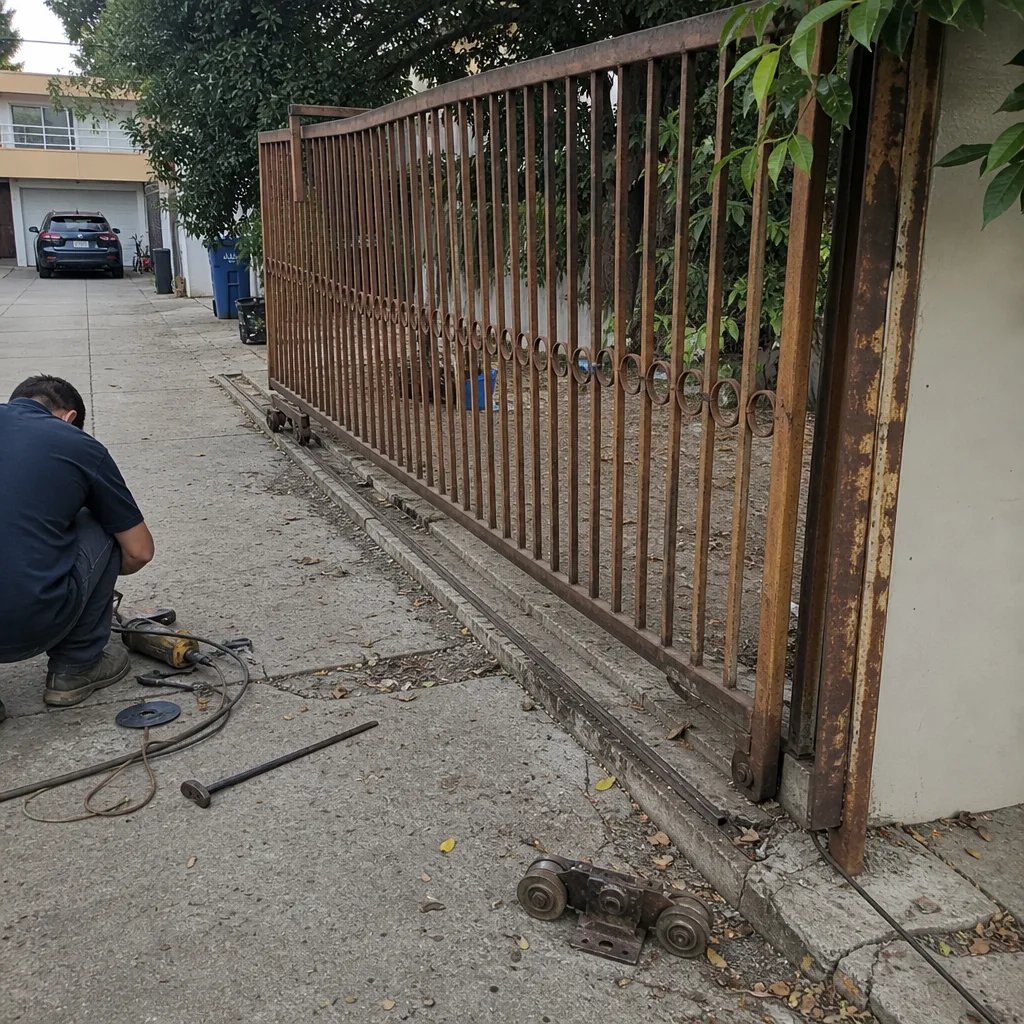
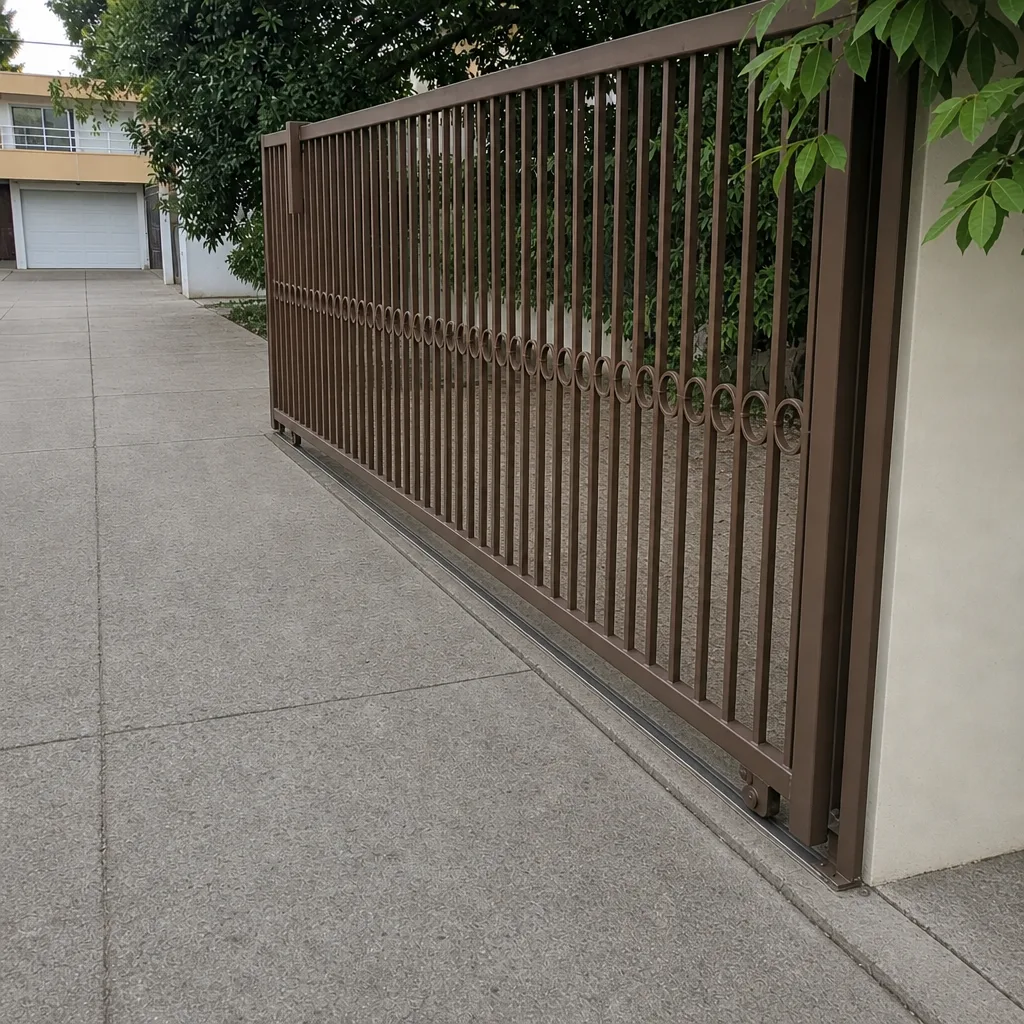
Track-mounted sliding gates have a ground track that fills with debris. On a hillside property where runoff carries dirt and gravel, that track is where most jams begin. When a tracked gate starts dragging or jumping, look at the track before you look at the motor.
Swing gates (single and dual leaf)
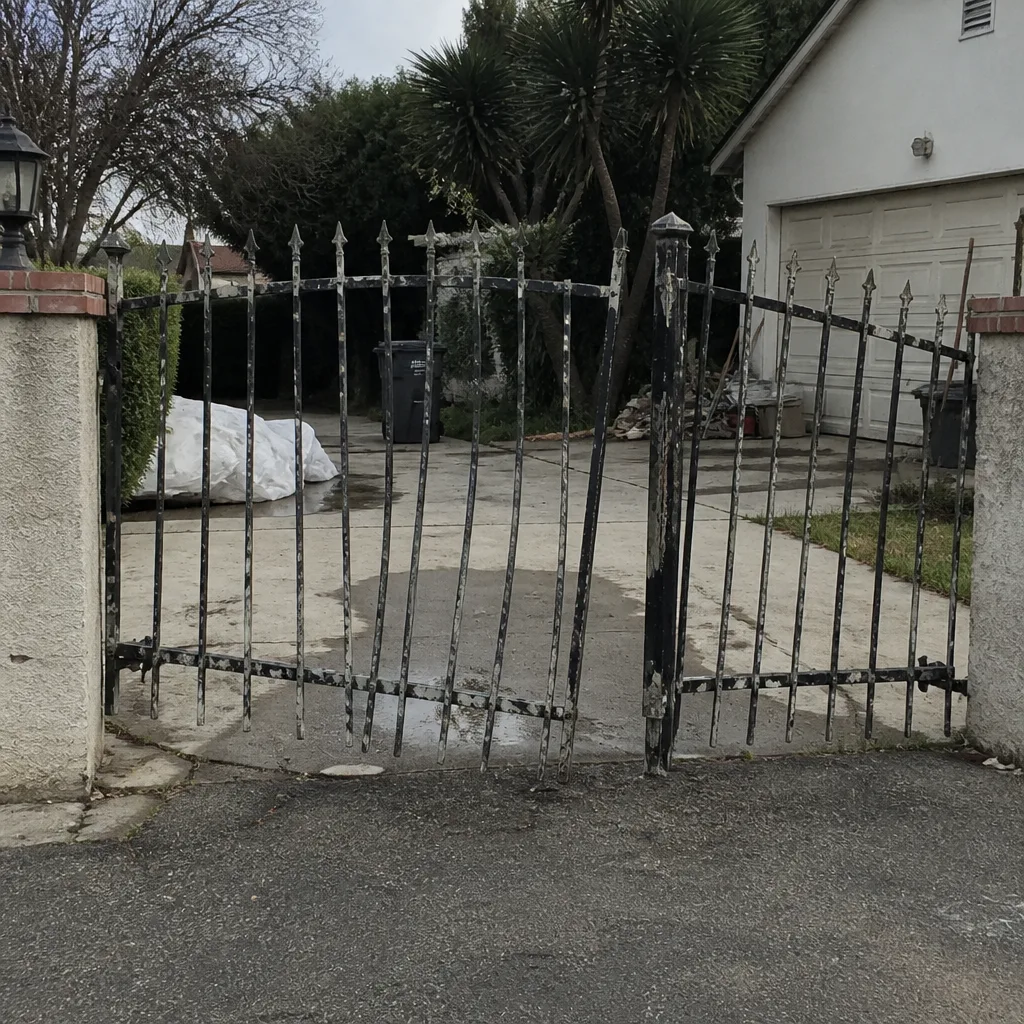
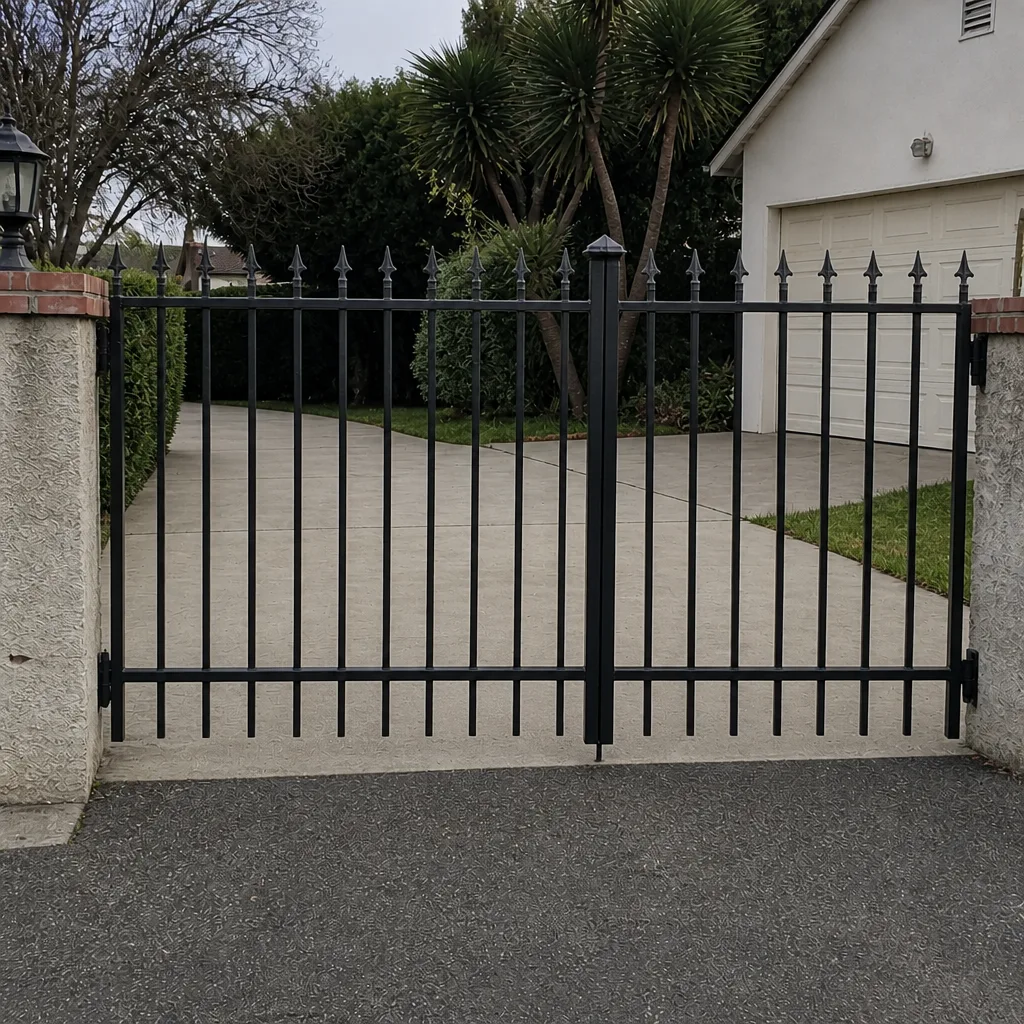
Swing gates are the classic estate or driveway look. Repair needs differ by leaf count. A single swing gate has one hinge point, so it either swings true or it doesn’t – simpler to diagnose. A dual swing gate has two operators and two limit positions to coordinate, so one leaf sagging while the other is fine is a very common pattern. That asymmetry alone is worth a diagnosis, because it usually means hinge wear on the sagging side, and a technician who just adjusts the operator limits won’t fix the underlying problem.
Pedestrian gates
Pedestrian gates are smaller, but they aren’t toys. A pedestrian gate is often the most-used entrance on a property, which means accelerated hinge wear and more frequent latch and closer issues. On security-conscious properties, pedestrian gates also carry the access controls – keypads, card readers, intercoms – and those are a different repair category entirely.
Estate and commercial vehicular gates
Larger estate gates and commercial vehicular gates take the heaviest loads. A commercial-grade sliding gate on a multi-unit property may cycle dozens of times a day, which wears rollers, operators, and safety devices far faster than a residence. This is where brand-specific knowledge matters most, because commercial-grade operators such as BFT and DoorKing have their own diagnostics, their own diagnostic codes, and their own failure patterns. Treating a commercial operator like a residential one is a shortcut that costs you later.
What a Legitimate Gate Specialist Does in the First Ten Minutes
The first ten minutes of a service call tell you almost everything about whether you’ve hired the right person. A gate specialist follows a diagnostic sequence. A generalist looks at the gate, shrugs, and starts swapping parts. Here’s the sequence, and what each step is actually looking for.
- Walk the gate’s full travel manually. Before touching power, before probing anything, a specialist releases the operator and pushes the gate through its entire cycle by hand. This separates mechanical from electrical instantly. If the gate binds anywhere in that travel, the operator isn’t the primary problem no matter what it’s doing.
- Inspect every wear point on the mechanical side. Hinges, rollers, tracks, guide posts, and the gate’s frame. A gate that’s racked by a few millimeters will fight a healthy operator. A specialist checks that the gate is square before doing anything else.
- Test the power supply under load. Not just “is there voltage,” but “does the voltage hold when the operator draws current.” Marginal supply looks fine at rest and collapses under a real cycle.
- Read the operator’s own diagnostics. Modern operators – especially FAAC, BFT, LiftMaster, and DoorKing controllers – report fault codes and status LEDs. Those codes tell a trained technician what the control board thinks is wrong. A generalist who doesn’t read those codes is guessing. This is one of the biggest reasons brand-specific repair matters so much.
- Test every safety and access device individually. Photo eyes, safety edges, loop detectors, keypads, receivers, and wall stations. If a safety device is telling the board to reverse, everything downstream looks broken when it isn’t.
- Look at the gate’s environment. Track debris, vegetation growth, ground settling at the footing, and water intrusion at the control box are all visible in that first look. These are the actual causes of a large share of the “mystery” failures.
After that sequence, a specialist can usually tell you within the same visit what’s actually wrong, what it will cost to fix it, and whether the repair makes sense long term. A generalist typically recommends “a new motor” – and that’s the trap. If you’d rather start with a free on-site estimate from a gate repair specialist, that’s the fastest path to an accurate answer.
Brand-Specific Repair: Why It Matters for Your Gate in Glendale
Gate operators are not universal. Each brand has its own diagnostics, its own control architecture, and its own failure patterns. A technician who works across brands every day develops pattern recognition that a generalist can’t. That’s why we service nine named brands – LiftMaster, FAAC, BFT, Linear, Viking, Ghost Controls, DoorKing, Elite, and Mighty Mule – because a residential gate in Glendale might be running a Mighty Mule DIY-grade operator while the property next door runs a commercial BFT operator on a heavy sliding gate, and the two demand completely different expertise.
On the residential side, Mighty Mule and Ghost Controls are common on smaller swing gates and pedestrian gates. They’re approachable systems, but they aren’t foolproof, and the failures tend to be consistent – control board firmware quirks, receiver pairing issues, and limit switch drift on swing-arm operators. Linear and Viking operators show up on mid-size residential gates and are excellent when configured well; misconfigured limits and undersized power are the recurring problems we see.
On the professional and commercial side, FAAC and DoorKing demand respect. These operators are built for high cycle counts and heavy gates, and their control boards report detailed diagnostic information that must be read correctly. A technician who treats a DoorKing controller like a Mighty Mule controller will cause damage. This is where gate specialization matters – we work on the brand you already have, and we know its actual behavior.
- Residential-grade operators: Mighty Mule, Ghost Controls – common failures are control board issues, receiver pairing, and limit drift.
- Mid-tier residential and light commercial: Linear, Viking, Elite – common failures are limit configuration, power supply, and arm wear.
- Commercial and high-security: FAAC, BFT, DoorKing, LiftMaster – common failures are control board faults, loop detector wiring, safety device failures, and heavy-cycle wear.
If your operator isn’t one of those nine, a specialist can still diagnose it. But if it is, you get the exact-match expertise – not a workaround, not a guess.
Repair or Redesign: When a Band-Aid Isn’t Enough
Not every gate problem needs the same kind of fix. Some calls are a component replacement, some are a system reset, and some are a signal that the underlying system has reached the end of its design life. Knowing which is which prevents you from pouring money into something that will fail again.
A repair is the right answer when the gate and its infrastructure are fundamentally sound and a specific part has failed. A worn hinge, a failed safety edge, a dead loop detector, a receiver that stopped pairing – these are one-time fixes. Do the fix, and the system returns to normal operation.
A band-aid is when the same failure recurs because the root cause was never addressed. If your operator keeps burning out a component, the power supply or one of the downstream mechanical conditions is stressing it. If your sliding gate keeps binding, the footing or the rollers are the real problem, and replacing the motor again won’t help. If your swing gate keeps sagging on one side, the hinge is failing and adjusting the operator won’t stop it. A specialist tells you honestly when a repair would just kick the problem down the road.
A redesign is warranted when the gate’s mechanical structure, operator, or control system no longer matches the property’s needs. Common examples include a residential-grade operator pushed into a commercial cycle count, a manual gate that should be automated, a gate whose geometry was wrong from the start, or a gate whose access controls no longer match who needs to get in. That’s a different kind of project – a measure, a design, an order, and a scheduled install – and it needs to be discussed as such, not as a same-day repair. We handle both repair and installation because the two decisions belong in the same conversation; you shouldn’t need a second vendor to get an honest answer.
What Gate Repair Costs in Glendale
Cost is the question everyone actually wants answered, so let’s be direct. Gate repair is priced per job, and the right number depends on the gate, the operator, and the specific failure. What we can tell you is how the pricing works and what to expect in broad terms. Every job starts with a free on-site estimate, and the price is quoted and agreed before any work begins. The written estimate sets the final price – not a phone guess, not a time-and-materials surprise.
| Category | What It Covers | Typical Pricing Approach |
|---|---|---|
| Diagnostic visit | Full diagnosis, written estimate | Free |
| Mechanical repair | Hinges, rollers, tracks, guide posts, frame adjustment | Per job, quoted after diagnosis |
| Electrical repair | Power supply, transformer, wiring faults | Per job, quoted after diagnosis |
| Operator repair | Motor, control board, capacitor, receiver | Per job, quoted after diagnosis |
| Automation and access repair | Remotes, keypads, loop detectors, safety edges, intercoms | Per job, quoted after diagnosis |
| Full system replacement | Gate and operator replacement | Measured, ordered, scheduled |
A mechanical repair on a residential swing gate is a very different job from a commercial operator control board replacement on a cantilever sliding gate, and the pricing reflects that. What we won’t do is quote you a number over the phone that has no relationship to what the job actually involves, or surprise you with an invoice bigger than the quote. The quote is the quote.
If your gate is beyond economic repair, we’ll tell you so and discuss replacement honestly. A free estimate from our team will tell you exactly where you stand. Glendale homeowners get the same diagnostic sequence we run on commercial properties – no shortcuts, no guesswork on price.
Prevention and Routine Care for Your Glendale Gate
Most gate failures don’t happen overnight. They build from small, ignored issues. A little prevention goes a long way, especially on hillside properties where runoff, vegetation, and settling all work against the gate every day.
- Keep the track and rollers clean. Especially on tracked sliding gates – debris is the number-one cause of jams on hillside properties. Clear the track periodically and look for settled material.
- Lubricate moving parts on the hinge and roller side. Hinges, rollers, and guide posts need lubrication. Dry metal wears fast and eventually binds.
- Test the manual release. Every few months, disengage the operator and move the gate by hand. If it feels stiff or binds, you want to catch it before it strains a motor.
- Trim vegetation away from the travel path. Overhanging branches and root growth are both common causes of intermittent gate faults.
- Test safety devices. Photo eyes, safety edges, and loop detectors should be tested with each cycle. A safety device that stops working cleanly is a liability.
- Look at the control box after rain. Water intrusion into a control box or operator enclosure causes more failures than people realize. A quick check after heavy weather catches it early.
- Listen to your gate. A new noise, a slower cycle, or a change in how the gate settles is a signal. The gate is telling you something needs attention – listen before the part fails outright.
None of this is complicated, and none of it requires tools beyond basic hand tools and a little attention. It’s the difference between a gate that gives you years of service and a gate that surprises you at the worst possible moment.
Common Mistakes to Avoid
- Replacing a motor when the problem is mechanical. If the gate binds when you release it manually, the operator isn’t the primary fault. A motor swap on a binding gate just burns out the new motor faster.
- Assuming a gate that won’t close is a broken operator. Nine times out of ten on Glendale properties, a gate that refuses to close is reading a safety device – a loop detector under the driveway or a misaligned photo eye – that’s reporting a phantom obstruction. The operator is doing exactly what it’s designed to do.
- Calling a general handyman for an automated gate. A gate operator is a control system. A handyman who treats it as a simple motor will miss diagnostics, misread fault codes, and turn a small fix into a replacement.
- Ignoring a hillside footing issue. On a cantilever sliding gate that suddenly starts dragging, the footing is the prime suspect, not the rollers. Replacing rollers while the footing is still shifting is the definition of a band-aid.
- Letting one leaf of a dual swing gate sag for months. Hinge wear accelerates the moment the gate drifts, and what starts as a small hinge replacement becomes a hinge, operator, and frame repair.
- Assuming a cheap fix means a permanent one. A quoted repair should address the root cause. If a technician won’t tell you why the part failed, the repair probably won’t hold.
- Skipping the free on-site estimate on the assumption a phone quote is accurate. No honest gate specialist can price a repair without seeing the gate. A free on-site estimate costs you nothing and gets you a real number.
See the difference
 Before
 After
 Before
 After
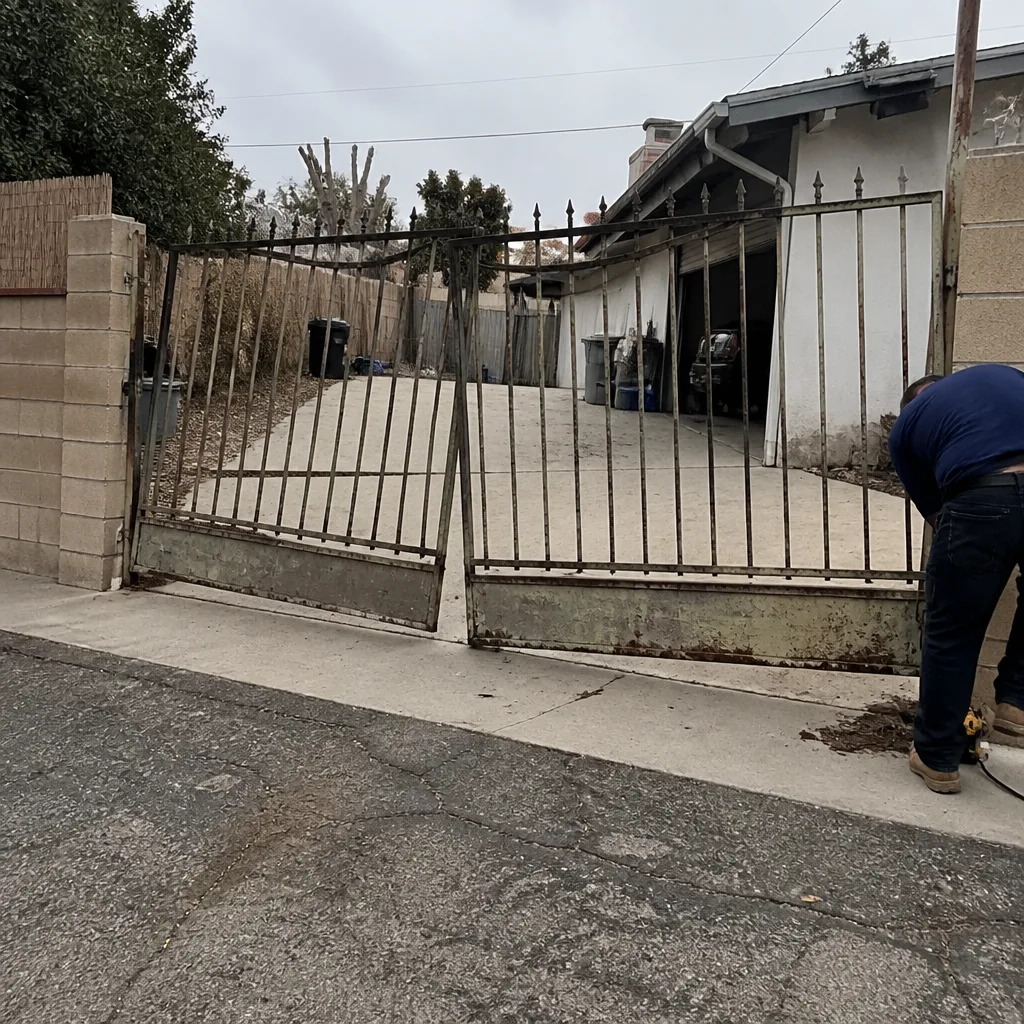 Before
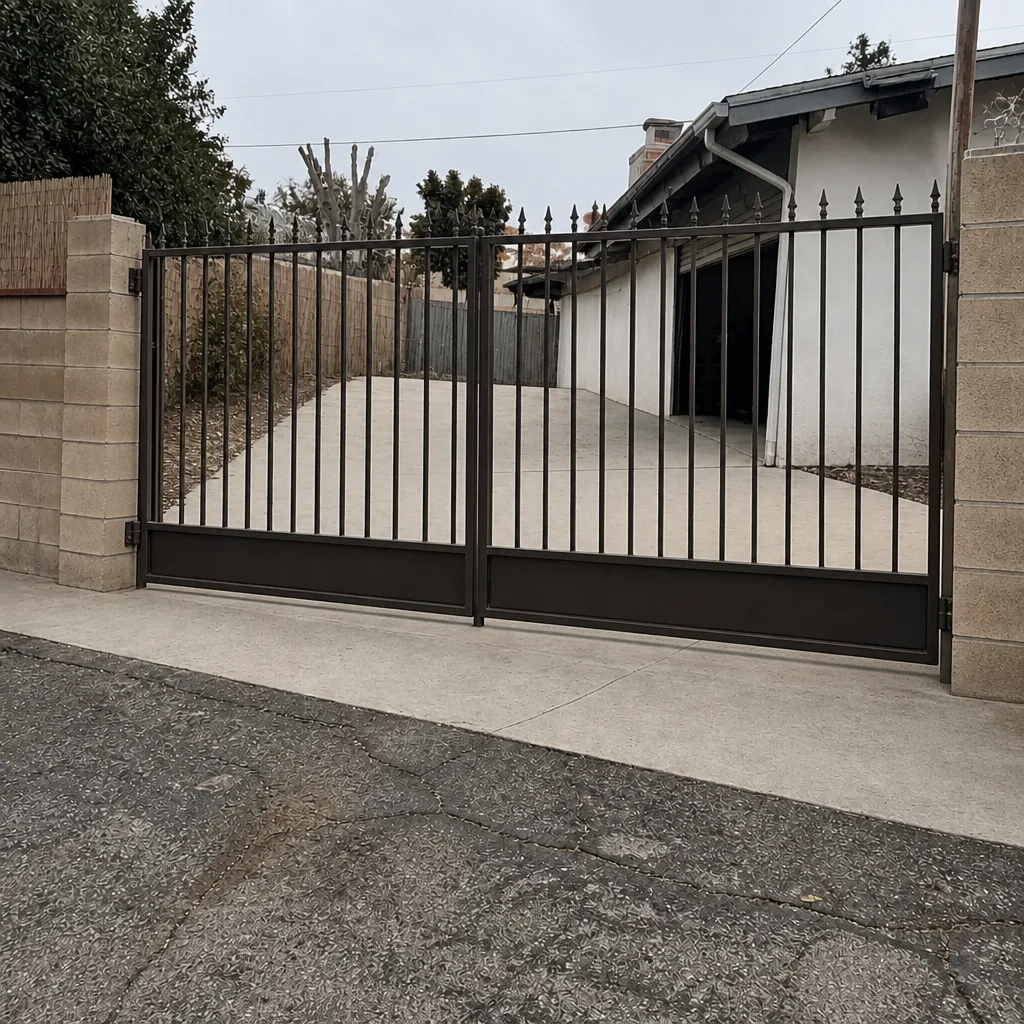 After
When to Call a Professional
Some gate problems are worth a little observation before you call anyone – listening to the operator, trying the manual release, checking the breaker. But a few scenarios warrant a call to a specialist right away. If your gate binds or drags under manual operation, if the operator hums without moving the gate, if the gate reverses mid-cycle or refuses to close, if any electrical component looks scorched or smells hot, or if the gate exhibits an intermittent fault that comes and goes, get a trained professional out. Automated gate operators run on line voltage and involve heavy, moving hardware that can cause serious injury; if you’re not sure what’s wrong, don’t put your hands in it. A trained technician diagnoses the actual fault and quotes the repair before any work starts. Glendale Gate Repair offers free estimates in Glendale – call (888) 853-9043. We answer 24/7, with fast dispatch from 7am to 7pm, Sunday through Friday.
Frequently Asked Questions
Release the operator and try to move your gate by hand. If it moves freely, the problem is almost certainly electrical or automation-related, and the fault is in the power supply, control board, or a safety device. If it binds, drags, or won’t budge by hand, the problem is mechanical, and the operator isn’t the primary culprit. Call (888) 853-9043 for a free diagnostic estimate and we’ll confirm which category you’re in.
Repair topics can often be handled same-day when the parts are on hand and the job is straightforward. We answer 24/7, and we dispatch Sunday through Friday, 7am to 7pm. Call (888) 853-9043 and we’ll tell you the soonest we can get a technician out to look at the gate.
We service nine major brands: LiftMaster, FAAC, BFT, Linear, Viking, Ghost Controls, DoorKing, Elite, and Mighty Mule. That covers residential-grade systems and commercial-grade systems, so you don’t need to worry about whether we work on the brand you already have installed. Call (888) 853-9043 to confirm your model.
A gate that reverses mid-cycle is almost always reading a safety device that’s reporting a phantom obstruction. Common culprits are misaligned photo eyes, a safety edge that’s out of adjustment, or a loop detector under the driveway that’s lost its tune or been damaged by settling. This is one of the most common calls we get on Glendale hillside properties. Call (888) 853-9043 for a free estimate.
Yes. Electric gate repair is a core part of what we do, including motors, operators, control boards, loop detectors, safety edges, keypads, receivers, and intercoms. If the gate needs new power or new safety components, that’s part of the diagnostic and repair scope. Call (888) 853-9043 for a free estimate.
That depends on the gate’s mechanical condition, the operator’s cycle count, and whether the underlying design still suits the property. A gate in good structural shape with a single failed component is usually worth repairing. A gate with a failing footing, a worn operator at the end of its cycle life, or geometry that never worked well on a hillside lot is often a candidate for replacement. We’ll tell you honestly which one makes sense. Call (888) 853-9043 for a free estimate.
The Bottom Line
Most gate repair problems in Glendale come down to diagnosis, not luck. Mechanical failures, electrical failures, and automation failures each look different once you know what to look for – and the cost of misdiagnosis is paying twice for the same underlying fault. Gate-exclusive specialization matters because the first ten minutes of a proper diagnostic sequence are where the real answer gets found, and generalists routinely skip that step. Our technicians have up to 13 years of experience across nine named brands, from Mighty Mule and Ghost Controls on the residential side to FAAC, BFT, and DoorKing on the commercial side. We handle the full arc of repair, electric repair, and installation, and we tell you honestly when a repair is a band-aid and when the system needs redesign. Whether your gate is binding, reversing, or dead, the fastest path to a real answer is a free estimate.
Contact Us
If your gate is stuck, dragging, reversing, or just not acting right, call Glendale Gate Repair at (888) 853-9043 for a free estimate. We answer 24/7, with fast dispatch from 7am to 7pm, Sunday through Friday. Every job starts with a diagnostic, and the price is quoted and agreed before any work begins. Start with the team that works on gates and only gates – because a gate-exclusive specialist gets to the actual cause faster, and saves you from paying twice for the same problem.
Written by the team at Glendale Gate Repair.